

If you are an Indian student planning to study abroad, 2026 has changed the calculation in ways no one predicted. Australia long considered the default choice has placed India in its "highest-risk" visa category as of January 2026, and refusal rates for Indian applicants have climbed to 40% as of February 2026, according to ICEF Monitor. Meanwhile, New Zealand is quietly positioning itself as the smarter, steadier alternative.
This is not a generic pros-and-cons list. This article compares Australia and New Zealand on the five things that actually matter to Indian students: visa approval odds, cost, jobs, PR pathways, and post-study work rights with current data, not outdated estimates.
Quick Verdict: New Zealand is the safer, more affordable bet right now. Australia offers higher salaries and bigger universities, but the visa environment for Indian students has become genuinely hostile. Read on to find out which choice fits your specific profile.
The Big Picture Why Indian Students Are Rethinking Australia in 2026
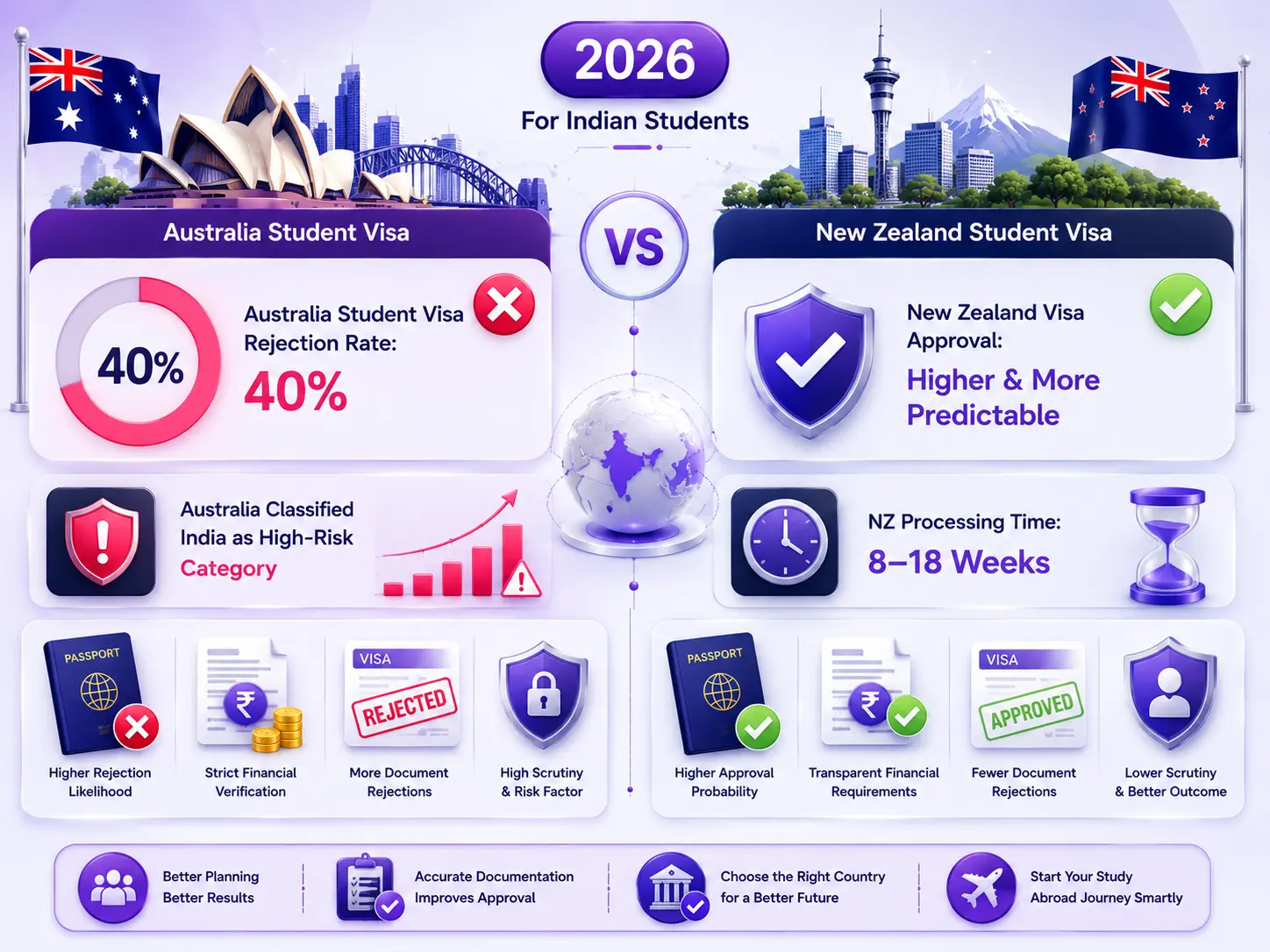
The numbers tell the story bluntly. Visa applications from Indian students to Australia fell by 33% between 2023–24 and 2024–25. In February 2026, one in every three students applying to an Australian university was rejected outright. For Indian applicants specifically, that refusal rate hit 40% compared to far lower rates for Chinese or European applicants.
Australia's Department of Home Affairs reclassified India under its highest visa-risk tier in January 2026. This does not ban Indian students from applying, but it triggers additional document scrutiny, longer processing times, and tighter financial verification. As GyanDhan CEO Ankit Mehra noted, "Students with legitimate academic profiles and clean financial documentation have nothing to fear, only a longer wait."
New Zealand, by contrast, has been moving in the opposite direction. From November 2025, student visa holders in New Zealand can work 25 hours per week during term (up from 20), and the post-study work pathway has been strengthened. The NZ–India Free Trade Deal signed in early 2026 also signals improving bilateral relations, with potential long-term benefits for job recognition and market access.
Cost of Studying Tuition Fees and Living Expenses Compared
For most Indian families, cost is the deciding factor. Here is where New Zealand holds a clear advantage.
Tuition fees in Australia typically range from AUD 20,000 to AUD 50,000 per year, depending on the program and university. In New Zealand, comparable programs cost NZD 22,000 to NZD 40,000 meaningfully lower after currency conversion.
Living costs are the bigger gap. The Australian government's own cost-of-living calculator estimates that a single international student needs AUD 27,000 –35,000 per year for a moderate lifestyle. New Zealand living costs average NZD 20,000 - 30,000 annually.
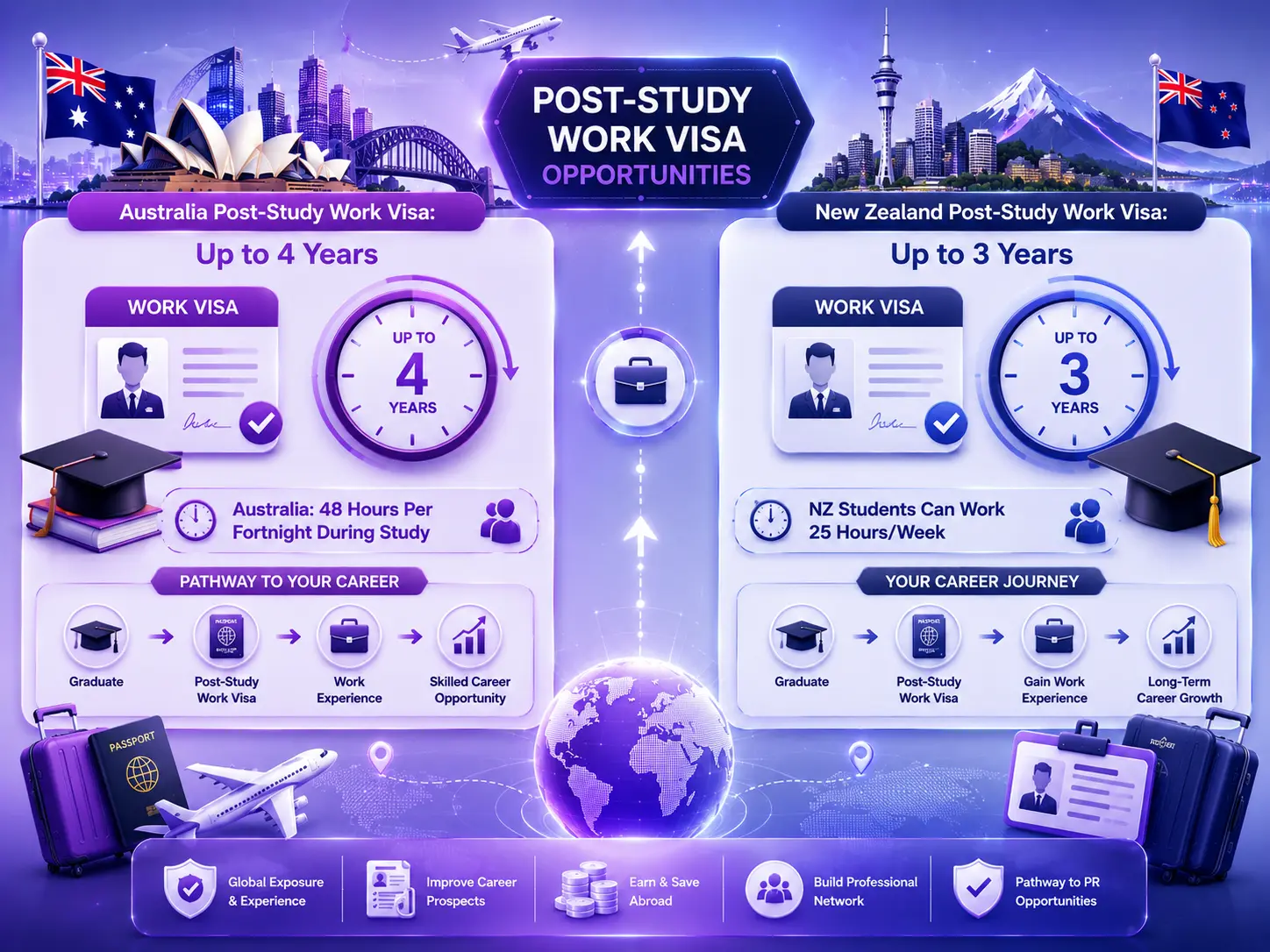
Part-time work income partially offsets costs in both countries. Australian students can work up to 48 hours per fortnight during term. New Zealand students can now work 25 hours per week a significant improvement that makes NZ more competitive for students who need part-time income to manage living expenses.
Both countries offer scholarships to Indian students, including university-level merit awards and government-funded programmes. Australia has more options due to its larger university sector, but New Zealand's awards are less competitive by volume of applicants.
Visa Approval Rates The Number Every Indian Student Must Know
This is the section most comparison articles skip. They tell you what documents to submit. They do not tell you your odds of success.
Australia (Subclass 500) — Current Reality for Indians
Australia's overall student visa approval rate is approximately 82–85%. For Indian applicants, the picture is significantly worse. In February 2026, the refusal rate for Indian university applicants hit 40%, according to ICEF Monitor the industry's leading source for international student data.
The reasons for rejection most commonly cited include insufficient or unverifiable financial documentation, low genuine student intent scores, inconsistent income proof, and weak ties to home country. From July 2024, student visa holders inside Australia can no longer switch to a student visa from certain other visa types, tightening the in-country pathway further.
New Zealand — A More Predictable Process
New Zealand's visa processing is comparatively faster and more predictable for Indian applicants. The NZ High Commission typically processes student visa applications within 8–18 weeks. While NZ does not publish nationality-specific refusal rates the way Australia does, anecdotal and agent-level data consistently shows lower rejection rates for Indian applicants compared to Australia's current environment.
Key requirements: IELTS 5.5–6.0 minimum (program-dependent), NZD 20,000 proof of funds, health insurance, and an offer from a recognised institution. The process is more straightforward, and the financial bar is lower.
Bottom line on visas: If your documentation is strong, you can get through in either country. But Australia's current environment means a 40% chance your application is refused regardless of intent a risk New Zealand does not carry at the same level right now.
PR Pathways Which Country Is Easier to Settle In?
Most Indian students are not just studying abroad. They are auditioning for permanent residency. This changes the calculation entirely.
Australia PR
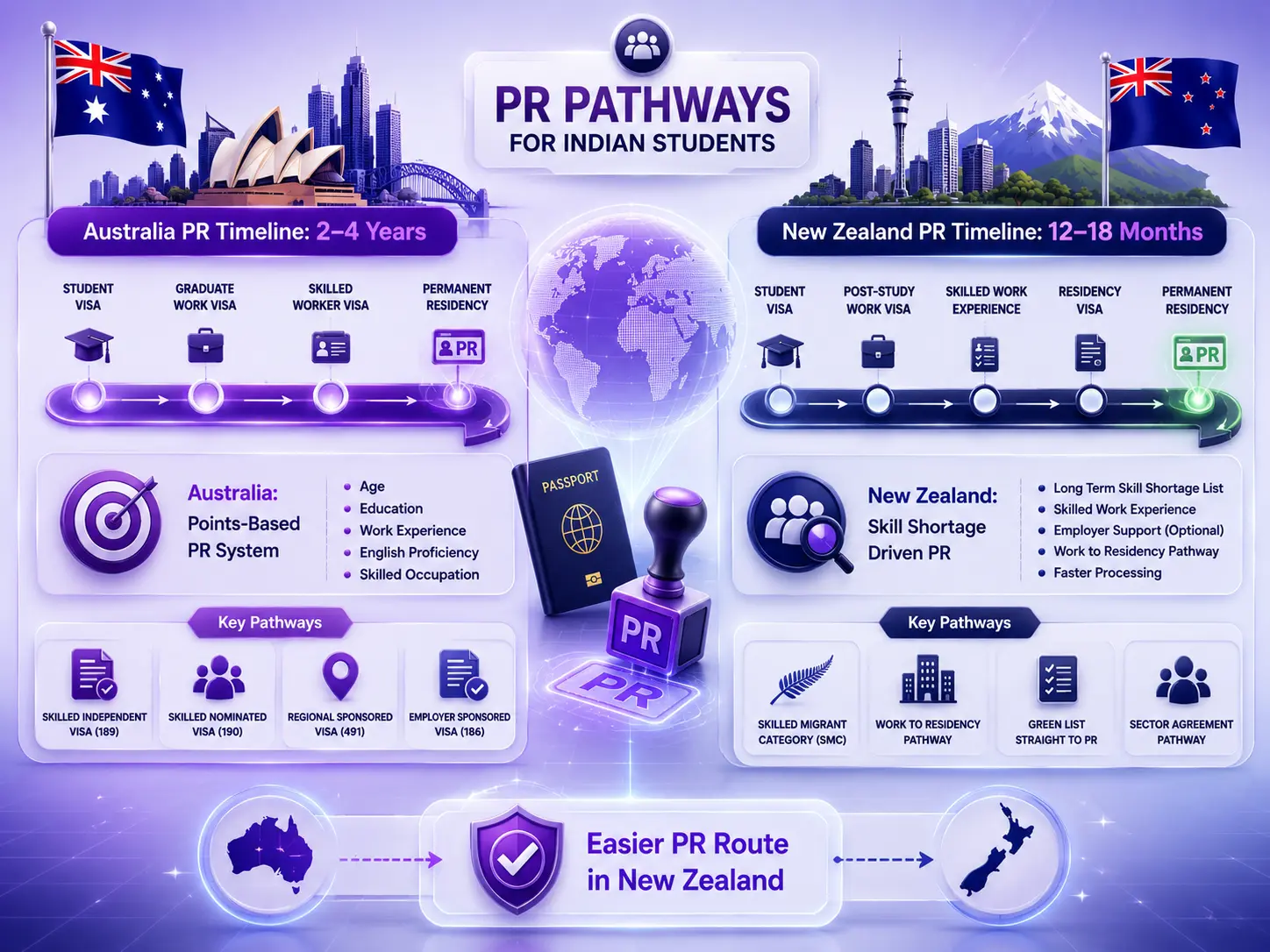
Australia's PR system is points-based, operating through the General Skilled Migration programme. You need a minimum of 65 points across factors including age, English proficiency, work experience, and qualifications. The main pathways are:
- Subclass 189 — independent, no state sponsorship required, highly competitive
- Subclass 190 — state-nominated, requires a job offer or strong ties to a specific state
- Subclass 491 — regional, offers a faster pathway but requires living outside major cities for a defined period
The process is thorough and can take 2–4 years from graduation to PR grant, assuming you are in an occupation with a reasonable invitation score. Certain high-demand occupations (nursing, engineering, software development, teaching) attract more invitations, but cutoff scores have been rising.
New Zealand PR
New Zealand's Skilled Migrant Category is widely considered more accessible for Indian graduates, particularly those who secure jobs in sectors on the Long-Term Skill Shortage List. There are no annual caps in the same way Australia's points-based system operates. If you find work in a shortage occupation, hold relevant qualifications, are under 55, and meet the financial and character requirements, your PR application has strong prospects.
Processing for New Zealand PR typically takes 12–18 months from application faster than Australia's more congested system.
PR verdict: New Zealand currently offers a more direct, faster, and less competitive PR route for Indian graduates who target in-demand sectors. Australia's PR system has more options but is more crowded and score-dependent.
Jobs and Salary Where Will You Actually Find Work ?
Australia's Job Market
Australia has a significantly larger and more diverse job market. IT, healthcare, engineering, finance, and trades are all in sustained demand. Sydney and Melbourne are major employment hubs with well-established Indian professional communities. Average graduate salaries in IT run AUD 70,000–90,000; in engineering and healthcare, often higher.
Post-study, the Temporary Graduate Visa (Subclass 485) allows 2 years for bachelor's and master's graduates, 3 years for master's by research, and up to 4 years for PhD graduates. Students who studied in regional areas receive an additional year.
New Zealand's Job Market
New Zealand has a smaller but talent-hungry job market. Because of the country's limited population, chronic skill shortages exist in IT, construction, engineering, healthcare, and agriculture. This actually improves hiring odds for Indian graduates you are entering a market that actively needs you.
Average IT salaries in Auckland run NZD 65,000–85,000. Healthcare and engineering are comparable. While absolute salaries are lower than Australia's, the cost of living adjustment narrows the gap considerably.
Post-study, New Zealand offers up to 3 years on the post-study work visa, and from November 2025, students can work 25 hours per week during their studies helping graduates build local work experience and employer relationships before graduation.
Jobs verdict: Australia offers higher absolute salaries and a bigger market. New Zealand is easier to break into, particularly in shortage sectors, and your qualifications carry more weight in a smaller talent pool.
Quality of Life The Factor Nobody Puts in a Spreadsheet
Australia offers the buzz of large, multicultural cities. Sydney and Melbourne have large, well established Indian communities, familiar food, cultural events, and a social infrastructure that many Indian students find immediately comfortable.
New Zealand offers something different smaller cities, easier commutes, a slower pace, and some of the most accessible outdoor environments in the world. Auckland and Wellington are genuinely liveable for students who want less urban intensity.
On safety, both countries rank highly by global standards. New Zealand's crime rates in major cities are lower than Australia's. Healthcare access is broadly comparable, with both countries offering international students access to health services (New Zealand extends public healthcare access to students on visas over two years).
Head-to-Head Verdict Which Country Should You Choose?
Choose Australia If:
- You have a strong academic and financial profile that can withstand heightened visa scrutiny
- You are targeting high-paying roles in IT, finance, or engineering in major cities
- You want access to Group of Eight universities and a broader research environment
- You are comfortable with a longer, more competitive PR process
Choose New Zealand If:
- You want a higher probability of visa approval and a less stressful application process
- Your budget is tight and you want lower tuition and living costs
- You are targeting shortage occupations and want a faster PR route
- You prefer a smaller, quieter city environment with genuine work-life balance
Factor | Australia | New Zealand |
Visa Approval Rate (Indians) | 60% (40% rejection) | Significantly higher |
Annual Cost (All-in) | ₹ 28–48 lakhs | ₹ 22–35 lakhs |
Post-Study Work Visa | Up to 4 years | Up to 3 years |
PR Accessibility | Moderate–Hard | Moderate |
Job Market Size | Large | Smaller but shortage-driven |
Average Salaries | Higher | Lower |
PR Timeline | 2–4 years | 12–18 months |
FAQ
Which country has a higher visa approval rate for Indian students in 2026? New Zealand. Australia placed India in its highest-risk visa category in January 2026, and Indian applicants faced a 40% refusal rate in February 2026. New Zealand's process remains more predictable and approachable for Indian applicants with solid documentation.
Is PR easier to get in New Zealand or Australia? New Zealand's Skilled Migrant Category is currently more accessible for Indian graduates who secure jobs in shortage sectors. Australia offers more PR subclass options but is more points-competitive, with longer processing times and higher cutoff scores.
How much cheaper is New Zealand than Australia for Indian students? All-in annual costs in New Zealand are approximately ₹ 5–10 lakhs lower than Australia, depending on city and program. New Zealand's tuition and living costs are both lower, and the proof-of-funds requirement for the visa is also less demanding.
Which country gives a longer post-study work visa? Australia offers up to 4 years for PhD graduates (Subclass 485). New Zealand caps at 3 years. However, New Zealand's post-study visa is currently easier for Indian graduates to obtain and comes with 25 hours per week of work rights during study.
Can Indian students bring their spouse while studying? In Australia, only master's and PhD students can include dependants on a student visa. In New Zealand, spouses can apply for visitor visas and work full-time if the student holds a work visa a slightly more flexible arrangement for postgraduate families.
If you are still confused between New Zealand and Australia, speaking with experienced study abroad consultants in Angamaly can help you make the right decision based on your budget, career goals, visa profile, and PR plans. The right guidance can improve your chances of visa approval, university selection, and long-term career success abroad. Whether you choose New Zealand or Australia, planning early with trusted study abroad consultants in Angamaly can make your 2026 study abroad journey smoother and more successful.