

If you are an Indian student planning to study in New Zealand or already enrolled there something significant happened on 3 November 2025 that directly affects your work rights, your visa conditions, and how you apply for or update your visa.
New Zealand rolled out a set of rule changes under its International Education Going for Growth Plan, and while the headlines focused on a 5 hour increase in weekly work hours, the full picture matters far more than that one number. This guide explains exactly what changed, who it applies to, and what Indian applicants need to do next.
Context worth knowing: as of 2025, there are nearly 12,000 Indian students enrolled in New Zealand representing 14% of all international students in the country. New Zealand's overall student visa approval rate climbed to 88.2% in 2025, up from 81.5% in 2024, and the approval rate for Indian nationals is now higher than in either of the two previous years. The conditions are improving. But only students who understand the current rules can take full advantage of them.
What Changed on 3 November 2025 The Core Updates
Three significant changes came into force on this date:
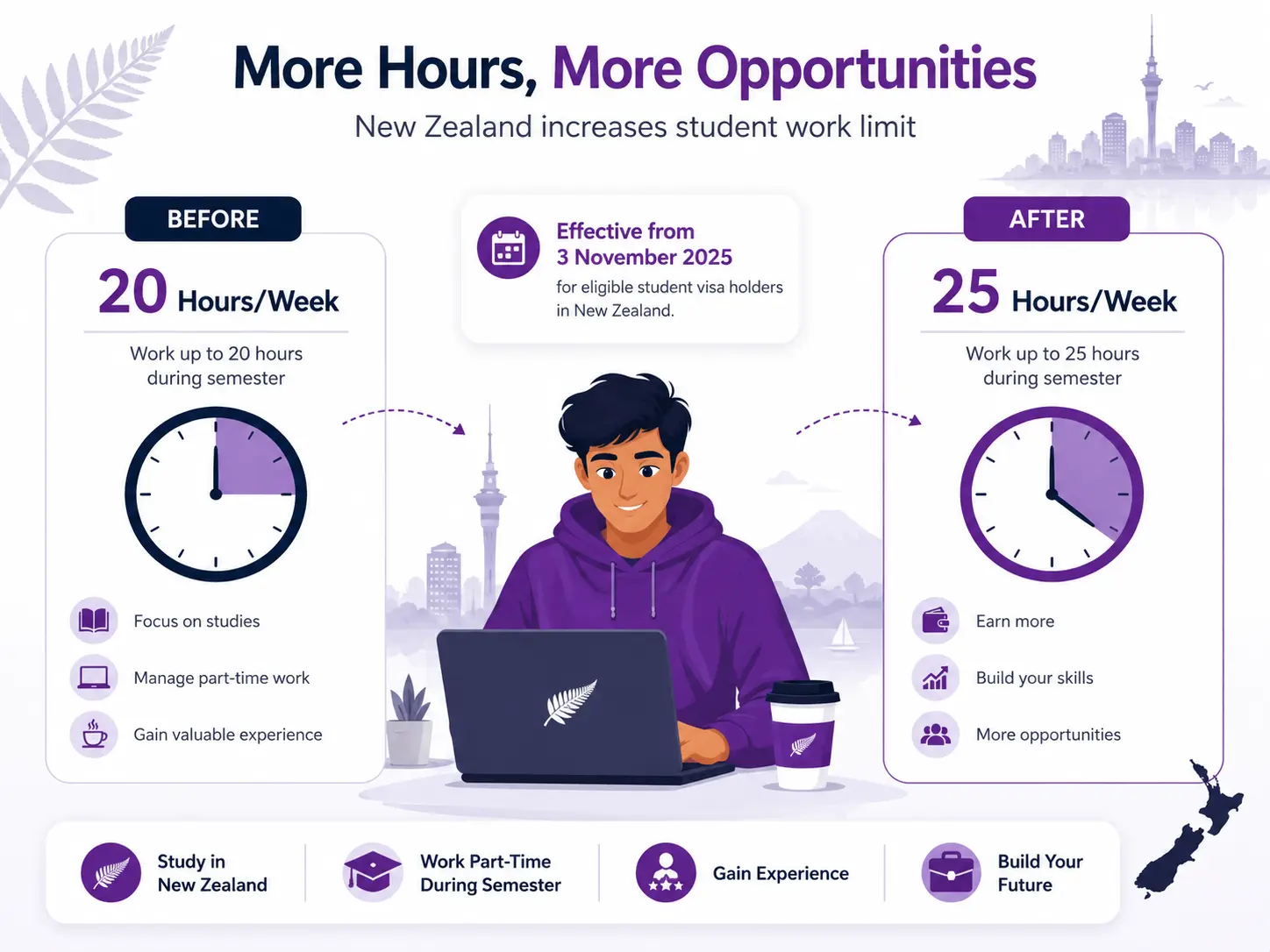
- Work hours increased from 20 to 25 per week. Eligible tertiary, English language, and secondary school students (Years 12 and 13) can now work up to 25 hours during the academic semester. Exchange and Study Abroad students including one-semester participants who previously had no work rights at all are now also eligible. PhD and Master's by research students continue to have unlimited work rights.
- All new student visa applications moved to Enhanced Immigration Online. Since 18 August 2025, every student visa application must be submitted through INZ's new digital portal. Paper applications are no longer accepted.
- Guardian Visitor Visa applications went fully online. From 3 November 2025, parents and guardians accompanying students must also apply through the Enhanced Immigration Online system.
The 25 Hour Work Limit What Indian Students Must Understand
The extra 5 hours are not automatic
This is the point most coverage misses. If you already hold a student visa with a 20-hour work condition, your visa still says 20 hours until you take action. Only new visas granted on or after 3 November 2025 automatically carry the 25 hour limit even if the underlying application was submitted earlier.
If your visa was granted before 3 November and you want to work up to 25 hours during semester, you must apply for a variation of conditions (fee: NZD $325).
Which variation of conditions process applies to you?
The process depends on which system your visa was issued under:
- Applied before 18 August 2025 (old system): Log in to the old Immigration Online portal and submit the specific work-hours variation form.
- Applied on or after 18 August 2025 (Enhanced system): Submit the variation of conditions directly through Enhanced Immigration Online.
If you are unsure which system issued your visa, contact INZ before applying using the wrong process wastes your NZD $325 fee.
Should you apply now or wait?
- Visa expiring within 3–4 months: Apply for a full renewal with the 25-hour condition included rather than paying for a variation first.
- Heading into summer break: If your visa already allows full-time work during breaks, you can wait until semester resumes and apply then, provided your visa is still valid.
- Mid-semester and want to use the extra hours now: Apply for the variation without delay.
Financial Proof The Indian Specific Requirements
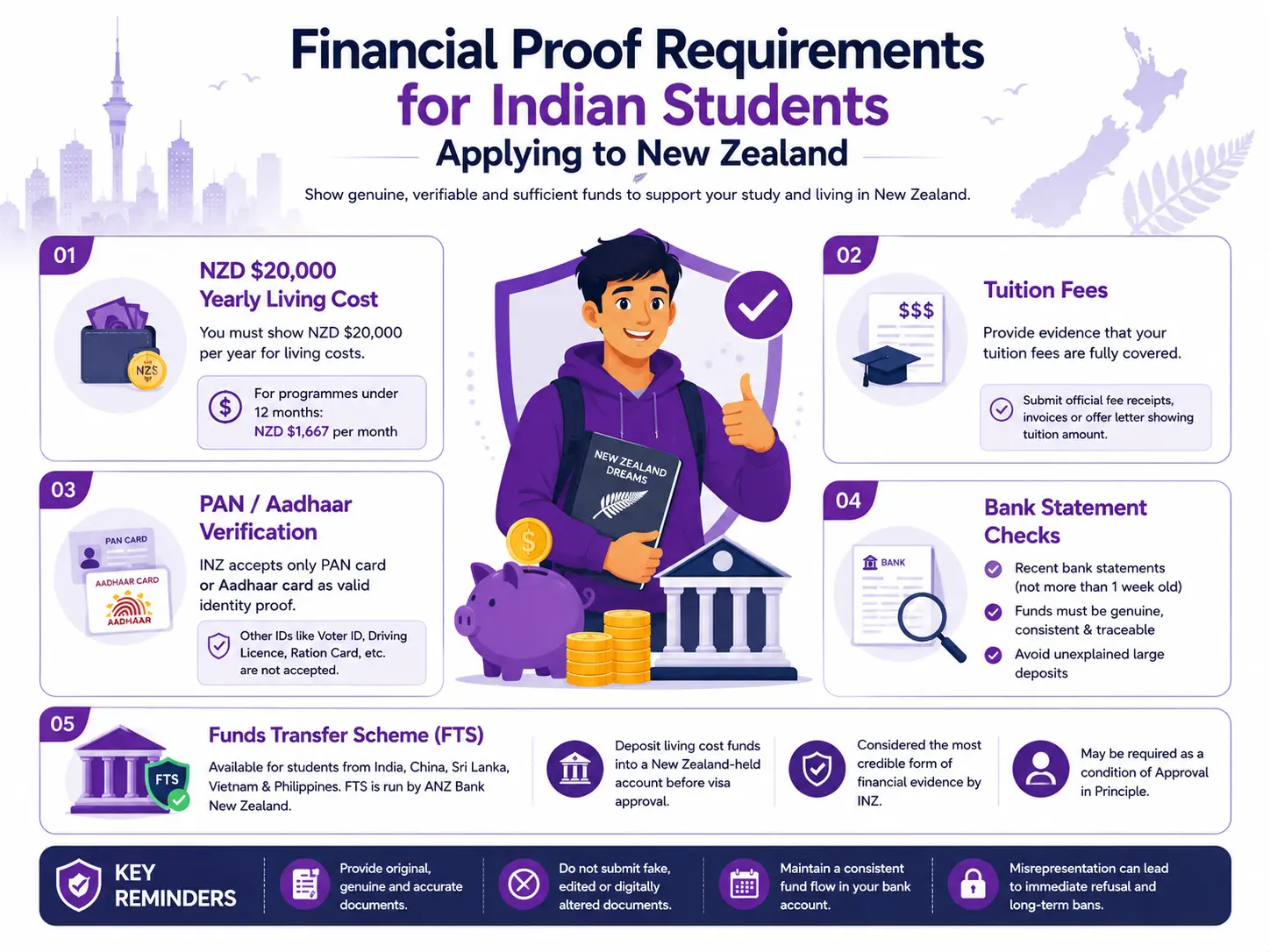
Financial documentation is where many Indian applications run into trouble. INZ applies careful scrutiny to applicants from India, and there are several India specific rules to know.
Minimum funds required: You must show NZD $20,000 per year for living costs (or NZD $1,667 per month for programmes under 12 months), plus separate evidence that tuition fees are covered.
Identity proof: INZ accepts only a PAN card or Aadhaar card from Indian applicants. Voter ID, ration cards, driving licences, and academic documents are explicitly not accepted.
The Funds Transfer Scheme (FTS): Available specifically for students from India, China, Sri Lanka, Vietnam, and the Philippines, the FTS is run by ANZ Bank New Zealand and allows you to deposit living cost funds into a New Zealand-held account before your visa is approved. INZ considers it the most credible form of financial evidence for Indian applicants. It is not always mandatory, but may be required as a condition of Approval in Principle.
Common mistakes that lead to rejection:
- Unexplained large deposits — funds must appear consistent and traceable over time
- Loans from gold lenders, chit funds, or informal sources — only nationalised or multinational bank loans are accepted
- Bank statements that are more than one week old at the time of lodgement
- Fraudulent or digitally altered documents — this results in immediate refusal and potential long-term bans
Photo rule: INZ uses facial recognition for identity verification. Visa photos must carry no filters, no AI enhancements, no skin smoothing, and no background edits. Many Indian applicants use studio photographers who apply automatic beauty filters this causes processing delays or rejections. Tell your photographer explicitly: no digital alterations of any kind.
Changing Your Course or Provider — A Critical Trap
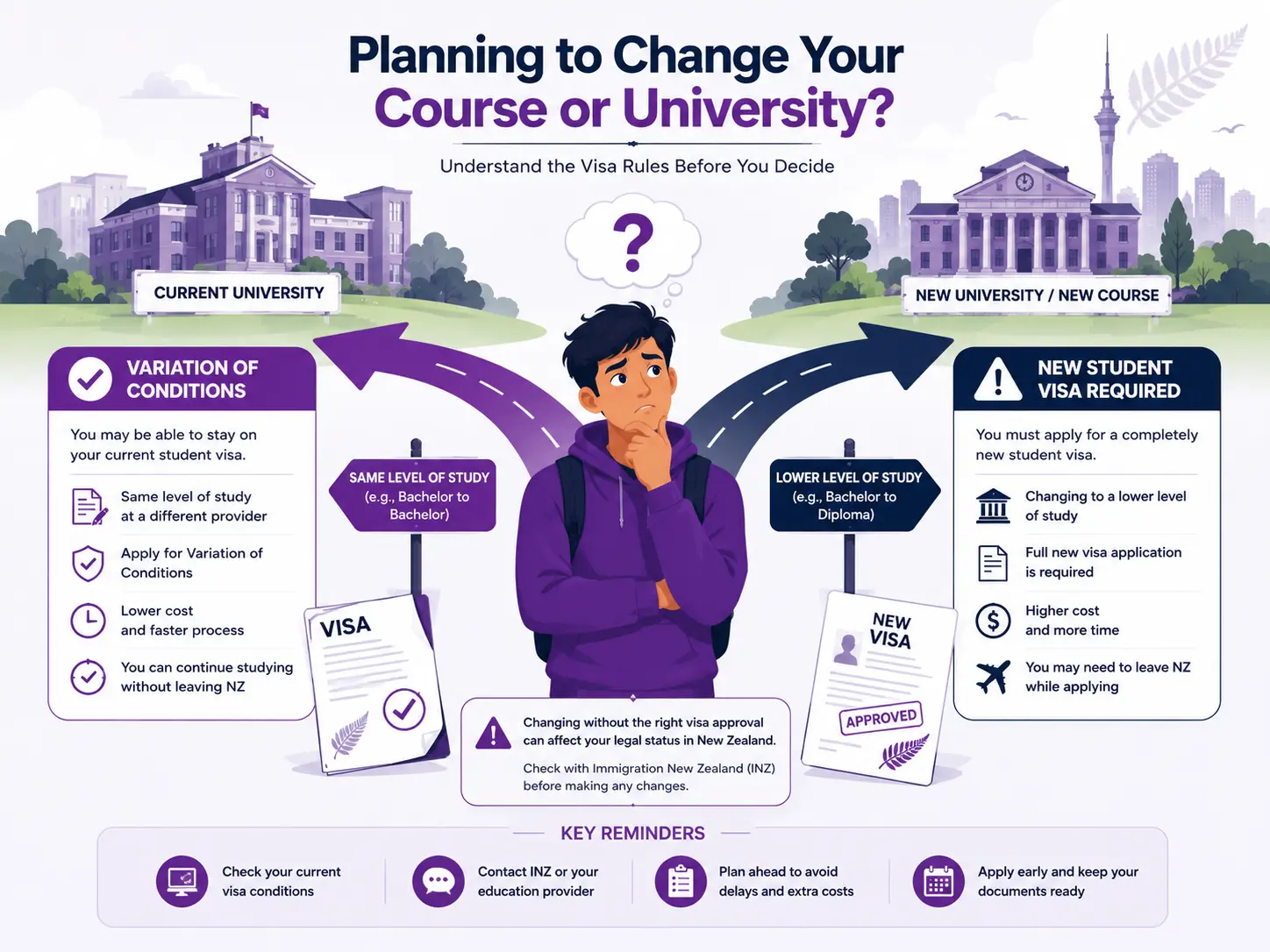
This is a rule that catches many Indian students off guard after they arrive in New Zealand.
If you want to change your education provider even if the new course is the same level or if you want to lower your level of study for example, switch from a bachelor's degree to a diploma, you must apply for a full new student visa. A variation of conditions does not cover this.
A new student visa means NZD $750–$850 in fees and 4–10 weeks of processing time. Plan ahead and get immigration advice before making any changes, not after.
The only exception: if the change is entirely beyond your control for example, your education provider closes unexpectedly INZ may consider a variation of conditions. Act quickly, document everything, and contact INZ immediately if this happens to you.
Frequently Asked Questions
Q: How many hours can Indian students work in New Zealand from November 2025?
Eligible tertiary, English language, and secondary school students can work up to 25 hours per week during semester up from 20 hours. Full-time work during scheduled breaks is unchanged. The extra 5 hours are not added automatically to existing visas; most current holders will need to apply for a variation of conditions for NZD $325.
Q: Is the Funds Transfer Scheme (FTS) mandatory for Indian students?
Not automatically, but it may be required by INZ as a condition of Approval in Principle. It is available for students from India, China, Sri Lanka, Vietnam, and the Philippines. Even when not required, using the FTS significantly strengthens a financial evidence package for Indian applicants.
Q: Can I just do a variation of conditions if I want to switch universities?
No. Changing your education provider at any course level requires a full new student visa application, not a variation of conditions. Budget for NZD $750–$850 and 4–10 weeks of processing time, and seek professional advice before making the switch.
Q: What identity documents does INZ accept from Indian applicants?
Only a PAN card or Aadhaar card. Voter ID, ration cards, driving licences, and all other Indian identity documents are not accepted by Immigration New Zealand.
What Indian Students Should Do Now
Here is a quick reference based on your current situation:
If you are applying for the first time: Apply through Enhanced Immigration Online at least 3–4 months before your course start date. Show NZD $20,000 per year in living costs, use PAN card or Aadhaar as identity proof, submit an unfiltered visa photo, and strongly consider using the Funds Transfer Scheme. Apply only to an NZQA-accredited institution.
If you already hold a student visa with a 20-hour work limit: The 25-hour increase is not automatic. Apply for a variation of conditions (NZD $325) through the correct portal based on when your visa was issued. If your visa expires within 3–4 months, wait and include the update in your renewal instead.
If you are thinking about changing your course or provider: Stop and get advice first. You will almost certainly need a full new student visa not a variation and the process takes time and money. Do not assume your current visa carries over.
The November 2025 changes are genuinely positive for Indian students: more earning capacity, extended rights for exchange students, and a faster digital system. But the financial documentation standards, the photo requirements, and the provider change rules all carry real risk if overlooked. If your situation involves any complexity a course change, unclear financials, or a provider issue Jerry's Educare can help you navigate it correctly before you submit anything. For straightforward queries, verify directly at immigration.govt.nz or enz.govt.nz. For personalised guidance, consult the team at Jerry's Educare.