

Every year, thousands of Indian students set their sights on a nursing career in the UK and for good reason. The UK offers NMC-accredited degrees, immediate access to NHS clinical placements, and a post-study work visa that gives you two years to build your career after graduation. But navigating the entire process from shortlisting universities to landing your first NHS contract requires precise, up-to-date information.
This guide covers everything you need to know about pursuing a BSc Nursing degree in the UK as an Indian student in 2026: eligibility criteria, top universities, realistic fees, scholarship options, the student visa process, and your career pathway once you graduate.
Why Indian Students Choose the UK for BSc Nursing in 2026
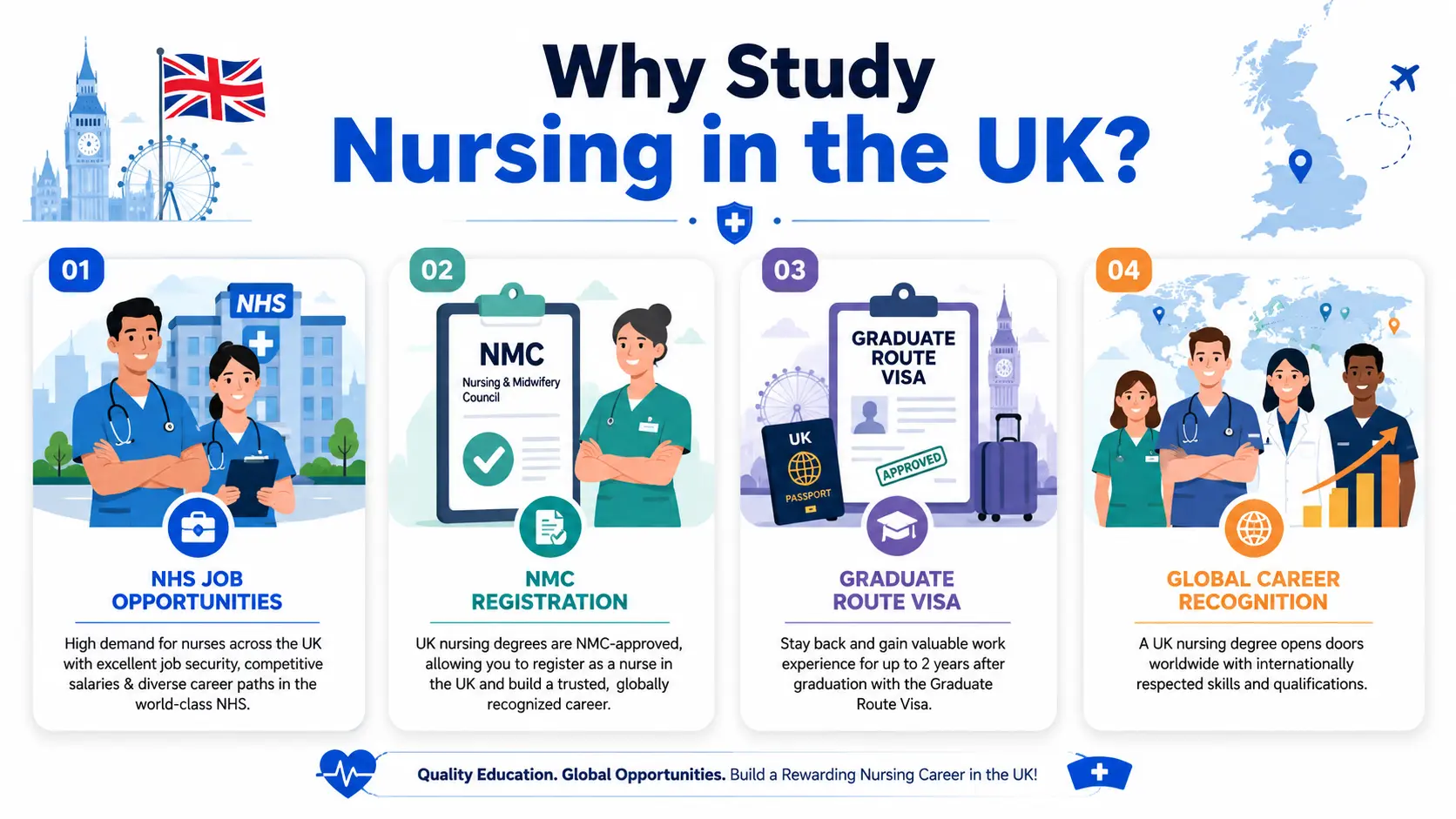
The UK is not just a good option for Indian nursing aspirants it is strategically one of the best. Here is why.
The NHS is in the midst of a staffing crisis. As of Q3 2024–25, there were over 106,000 vacancies in the NHS workforce, with 27,000 positions in nursing alone (NHS England, 2025). This demand translates directly into job security for international graduates who complete their degree in the UK.
Beyond employment prospects, a UK BSc Nursing degree carries a regulatory advantage that most students overlook. Graduates of an NMC-approved UK programme can register directly with the Nursing and Midwifery Council (NMC) upon graduation. Indian-trained nurses, by contrast, must clear the Overseas Nursing Programme (ONP) and the Computer-Based Test (CBT) plus Objective Structured Clinical Examination (OSCE) a process that can take 6 to 12 additional months and cost ₹1–2 lakhs in preparation and exam fees.
Additionally, over 21,000 Indian nurses have already registered to practise in the UK (NMC data), which means there are established Indian professional communities in virtually every NHS trust. And with the 2-year Graduate Route visa, you have ample time to secure employment before needing to transition to a Skilled Worker Visa.
Eligibility Criteria for BSc Nursing in UK (Indian Students)
Academic Qualifications
To be eligible for a BSc Nursing programme in the UK, Indian students typically need:
- 10+2 (or equivalent) with Physics, Chemistry, and Biology as core subjects
- A minimum aggregate of 60%–80% depending on the university (Russell Group universities tend to require 75%+)
Top UK Universities for BSc Nursing (2026)
NMC approval is the single most important factor when choosing a university without it, your degree will not qualify you for direct NMC registration. All universities listed below hold NMC approval.
University | QS World Rank 2026 | Annual Tuition (International) | Notable Strength |
King's College London | #31 | £26,200–£32,250 | Central London NHS placements |
University of Manchester | #35 | £23,500–£29,000 | Research-intensive programme |
University of Glasgow | #79 | £22,800–£26,500 | Strong Scottish NHS partnerships |
University of South Wales | #1251 | £14,950–£16,500 | Most affordable NMC approved option |
Nottingham Trent University | #609 | £15,500–£18,000 | High student satisfaction scores |
Post-92 universities such as South Wales and Nottingham Trent offer the same NMC-approved qualification as Russell Group universities at 30–40% lower tuition fees. For Indian students focused on clinical registration rather than academic prestige, these represent excellent value.
Scholarships and How to Offset Costs
While the NHS Bursary which once covered tuition for nursing students is no longer available to new international students, there are still meaningful funding options:
- Commonwealth Scholarships : Cover full tuition and living costs. Highly competitive selection based on academic merit and development impact.
- Chevening Scholarships: Primarily for postgraduate study, but some partner universities extend awards to undergraduates.
- British Council GREAT Scholarships: Available for Indian students in healthcare fields worth approximately £10,000 per year.
- Ariyaratnam Scholarship (University of South Wales): Worth up to £19,758 per year one of the most generous university-specific awards available to nursing students.
- Part-time work rights: International students on a Student Visa may work up to 20 hours per week during term time and full-time during official holidays. At the current National Living Wage (£11.44/hour for those 21+), this can generate £8,000–£11,000 per year towards living costs.
Given the heavy clinical placement workload in Year 2 and 3, most students realistically work 10–12 hours per week rather than the full 20.
How to Apply: Step-by-Step Admission Guide
BSc Nursing applications in the UK are submitted through UCAS (Universities and Colleges Admissions Service), not directly to universities. Here is the process:
Step 1 — Research & Shortlist: Identify 4–5 NMC-approved universities that fit your budget and academic profile. Use the NMC's Education Approval Register to verify accreditation.
Step 2 — Prepare your IELTS: Begin preparation early. Aim for a 7.0 in each band from the outset (the NMC standard), not just the lower admission threshold.
Step 3 — Write your Personal Statement: This is the most important part of a UCAS application. Reflect on why you want to be a nurse, any relevant clinical or caring experience, and your understanding of the NHS model of care.
Step 4 — Submit via UCAS: The main UCAS deadline for September 2026 entry is 29 January 2026. You can apply to up to 5 courses. Nursing is a popular choice, so apply early.
Step 5 — Accept your offer: Once you receive a conditional or unconditional offer, confirm your Firm choice through UCAS Track.
Step 6 — Apply for your Student Visa: After receiving your CAS (Confirmation of Acceptance for Studies) from the university, begin your visa application. Apply at least 6–8 weeks before your course start date.
UK Student Visa Guide for Indian Nursing Students (2026)
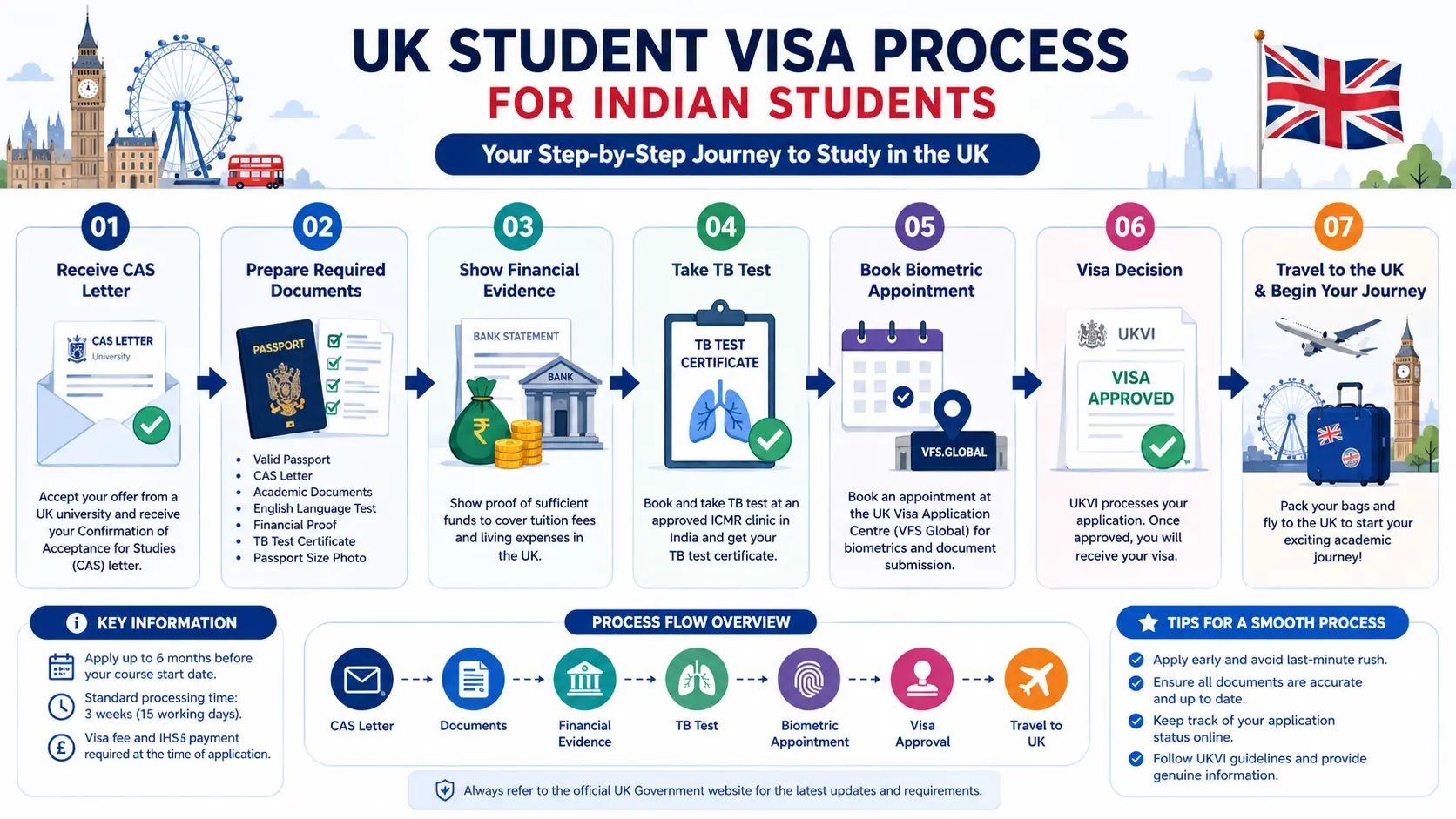
All Indian students require a Student Visa (formerly Tier 4) to study in the UK. Key requirements:
- A valid Confirmation of Acceptance for Studies (CAS) from your university
- Proof of funds: £1,483 per month for London; £1,136 per month outside London covering 9 months (the full academic year)
- IELTS or OET certificate meeting NMC standards
- TB (tuberculosis) test certificate from an approved clinic in India
- Valid passport with at least 6 months of remaining validity beyond your course end date
- Completed online visa application and biometric appointment
Visa fee: £524 | Processing time: typically 3–4 weeks after biometrics. Apply at the UK Visa Application Centre (VAC) nearest to you in India.
Once your visa is approved, you can arrive in the UK up to 1 month before your course start date (for courses longer than 6 months). Use this time to sort accommodation, open a UK bank account, and attend university orientation.
Career Opportunities After BSc Nursing in the UK
NMC Registration for UK-Trained Graduates
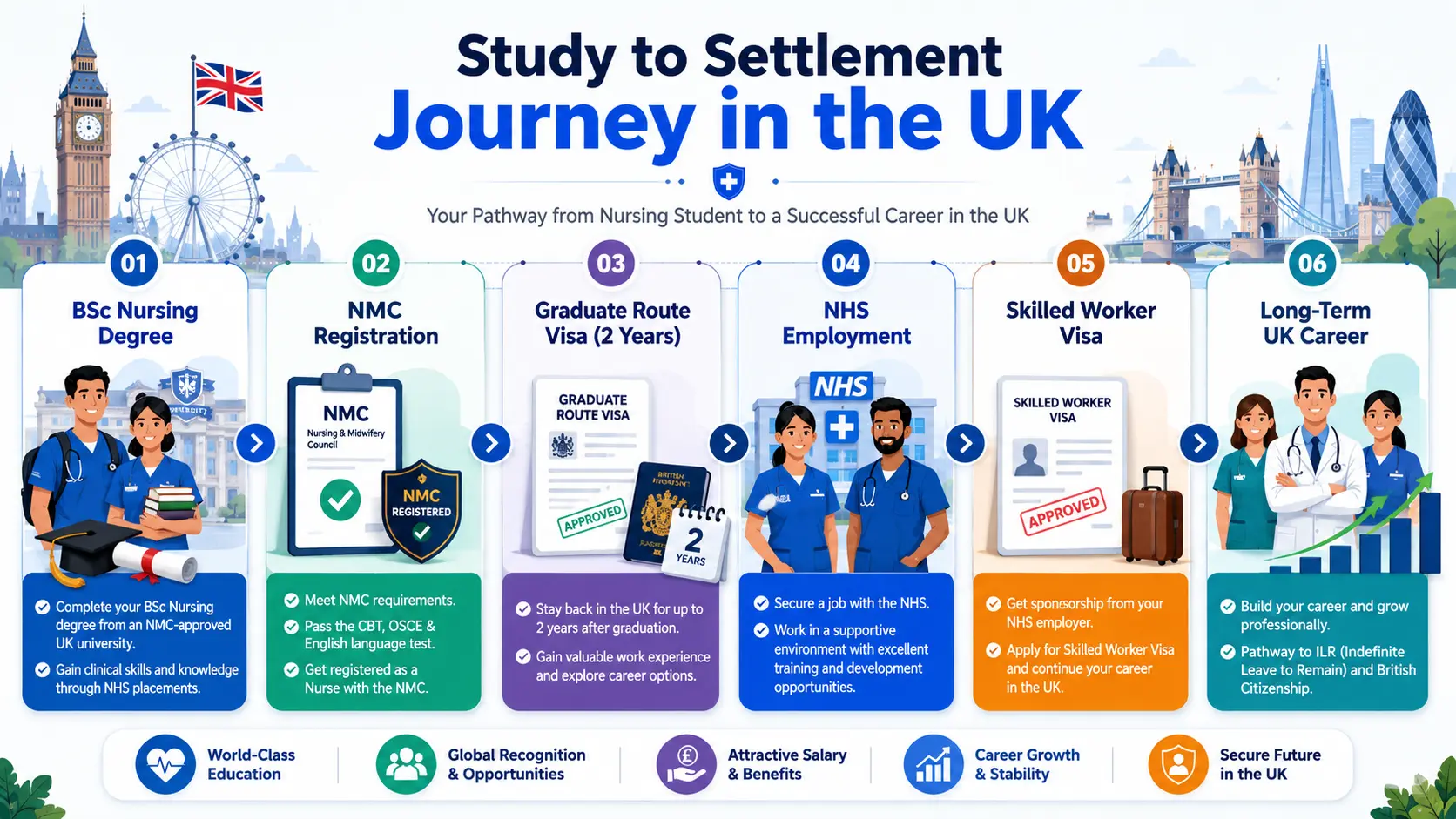
This is where studying in the UK pays off most clearly. Graduates of an NMC-approved UK BSc Nursing programme apply directly for NMC registration a streamlined process requiring submission of degree documents and a fitness-to-practise declaration. There is no OSCE examination required, unlike the pathway for Indian-trained nurses applying from abroad.
NHS Salary on Graduation (2025–26 Pay Scale)
NHS Band | Role | Annual Salary (GBP) | Annual Salary (INR approx.) |
Band 5 | Staff Nurse (newly qualified) | £28,407–£34,581 | ₹30–37 lakhs |
Band 6 | Senior Nurse / Specialist | £35,392–£42,618 | ₹37–45 lakhs |
Band 7 | Advanced Nurse Practitioner | £43,742–£50,056 | ₹46–53 lakhs |
The Graduate Route Visa: Your 2-Year Bridge
After completing your BSc Nursing degree, you are eligible to apply for the Graduate Route visa a 2-year post-study work visa that requires no job offer to apply. This gives you time to attend NHS interviews, secure a Band 5 contract, and then transition to a Skilled Worker Visa sponsored by your NHS employer.
This pathway is well-established: the NHS actively recruits internationally trained nurses and holds a sponsor licence, making the Skilled Worker Visa transition relatively straightforward for nursing graduates.
Frequently Asked Questions
Is a UK BSc Nursing degree valid in India?
Yes, but you must apply to the Indian Nursing Council (INC) for degree equivalency recognition before practising in India. The process involves submitting transcripts, clinical hours documentation, and your NMC certificate. This typically takes 3–6 months after returning.
Can I work part-time while studying BSc Nursing in the UK?
Yes. A Student Visa permits up to 20 hours per week during term time and full-time during holidays. However, BSc Nursing includes mandatory clinical placements that consume significant time, so most students realistically manage 10–12 paid hours per week without affecting their studies.
What nursing specialisations can I choose in the UK?
UK BSc Nursing programmes offer four NMC-regulated pathways: Adult Nursing, Child Nursing (Paediatrics), Mental Health Nursing, and Learning Disability Nursing. Adult Nursing is the most common choice for Indian students due to the highest NHS vacancy numbers and broadest career scope.
Final Thoughts
Pursuing a BSc Nursing degree in the UK in 2026 is one of the most strategically sound decisions an Indian student can make in the healthcare field. The combination of NMC accredited education, direct registration eligibility, an acute NHS demand for nurses, and a clear post-study work pathway makes the UK stand apart from other destinations.
The key is to plan carefully: target IELTS 7.0 bands from day one, choose an NMC-approved university that fits your budget (not just the rankings), apply through UCAS before January 2026, and factor in all costs including the IHS when planning your finances.
For students seeking expert guidance throughout the admission, visa, and university selection process, working with experienced Study Abroad Consultants in Angamaly can help simplify every stage of the application journey. Professional support ensures that students make informed decisions and maximize their chances of securing admission to leading UK nursing universities.