

If you're planning to study in Germany, the question of how much German you actually need can feel like a moving target. The honest answer is it depends on whether your program is taught in German or English. Many students seek guidance from study abroad consultants in Angamaly to understand these language requirements and choose the right pathway. Get that distinction right and the rest of the picture falls neatly into place.
And you're far from alone in asking. According to DAAD's Wissenschaft weltoffen 2025 data, India is now the single largest source of international students in Germany, with just under 59,000 Indian students enrolled a 20% jump in a single year. Roughly 60% of them are in engineering. So this is a well-trodden path, and the language requirements are entirely manageable once you know which one applies to you.
The Short Answer
Your Pathway | German Level Needed |
German-taught degree | B2 minimum, C1 is the standard |
English-taught degree | No German required (A2–B1 recommended for daily life) |
Studienkolleg (foundation year) | B1–B2 to enter, C1 to exit |
If you remember nothing else, remember this: the language of instruction decides everything.
Understanding the CEFR Levels
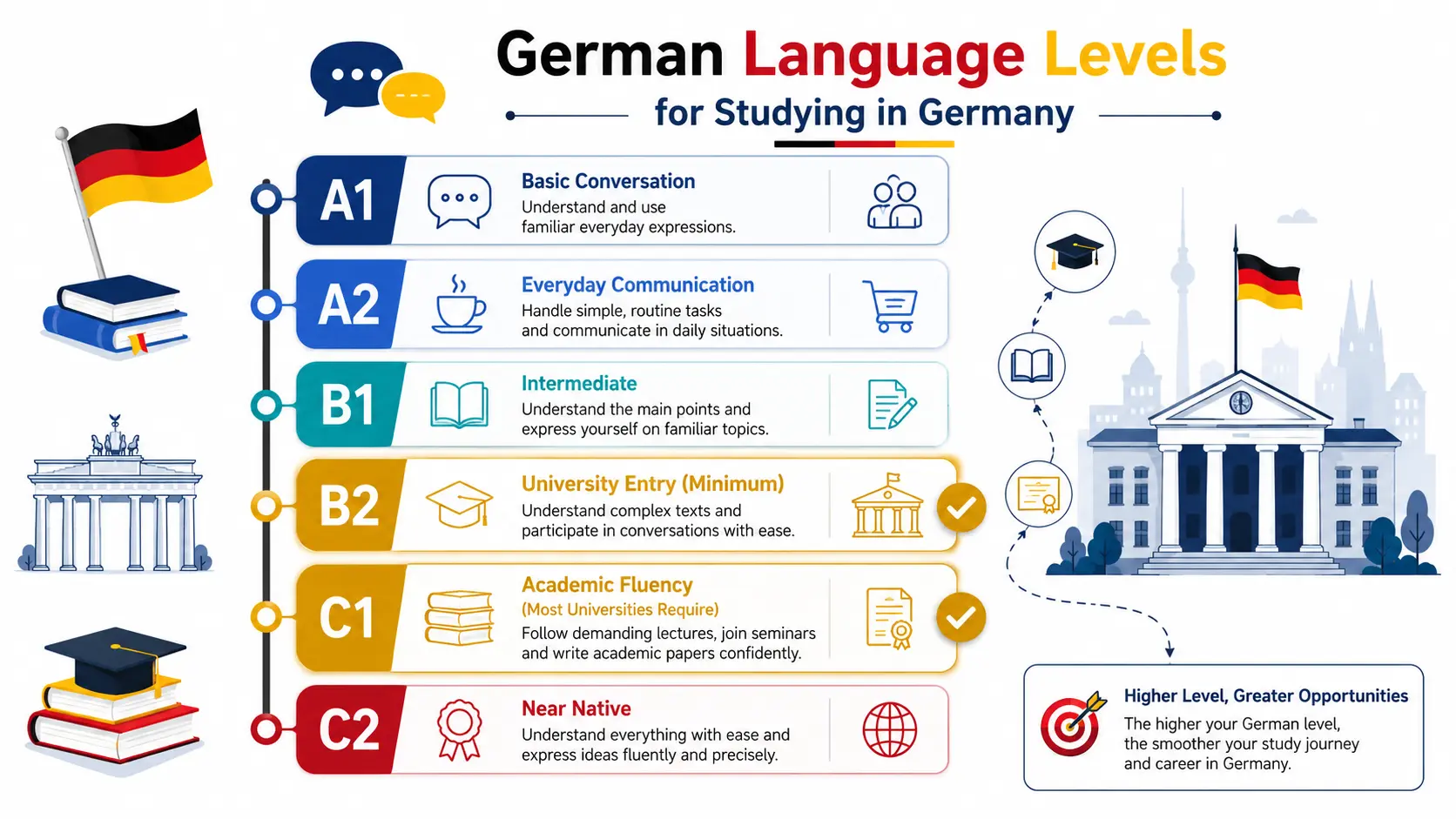
German proficiency is measured on the Common European Framework of Reference (CEFR), which runs from A1 (beginner) to C2 (near-native). Here's what each level means in a real university setting:
- A1–A2: Everyday phrases and basic conversation. Useful for settling in, but nowhere near enough for academic study.
- B1: You can handle routine situations and follow simple discussions still not sufficient for fast-paced lectures or academic essays.
- B2 (upper-intermediate): You understand complex texts and can hold your own in discussion. This is typically the minimum universities will accept.
- C1 (advanced): You can follow demanding lectures, join seminars, and write academic papers comfortably. This is the level German universities really want.
- C2: Near-native fluency, rarely required outside specialised fields like literature or philosophy.
The takeaway: for a German-taught degree, B1 and below simply won't get you admitted.
Which Level Do You Actually Need B2 or C1?
This is where most guides give a vague “B2 or C1” and leave you guessing. Here's the clearer version.
C1 is the safe bet. Most German-taught programs treat C1 as the standard because it's the level at which you can genuinely keep up with coursework rather than just scrape past the application stage.
B2 is sometimes accepted but usually with strings attached. Some universities offer conditional admission at B2 if you commit to reaching C1 before the semester begins. B2 may also be enough for certain dual-degree or preparatory programs. It's a workable entry point, but rarely the finish line.
C2 is rarely needed. Unless you're heading into advanced literature, linguistics, or philosophy, you won't be asked for it.
A useful way to think about it: B2 is often the level to apply, while C1 is the level to succeed. Plan for C1 and you'll never be caught short.
Do You Need German for English Taught Programs?
Here's the part many Indian students are relieved to discover. Germany offers around 2,400 English-taught programs, the bulk of them at master's level. For these, you prove your English ability through IELTS or TOEFL and German is not required for admission at all.
So if you're targeting an English-taught master's in engineering, data science, or management, you can apply without a word of German.
That said, learning some German still pays off. Reaching A2 or B1 makes your visa interview smoother, opens up part-time work and internships, and makes daily life far easier. It's an investment in your experience, not just your admission.
Accepted German Language Certificates (and Which to Take from India)
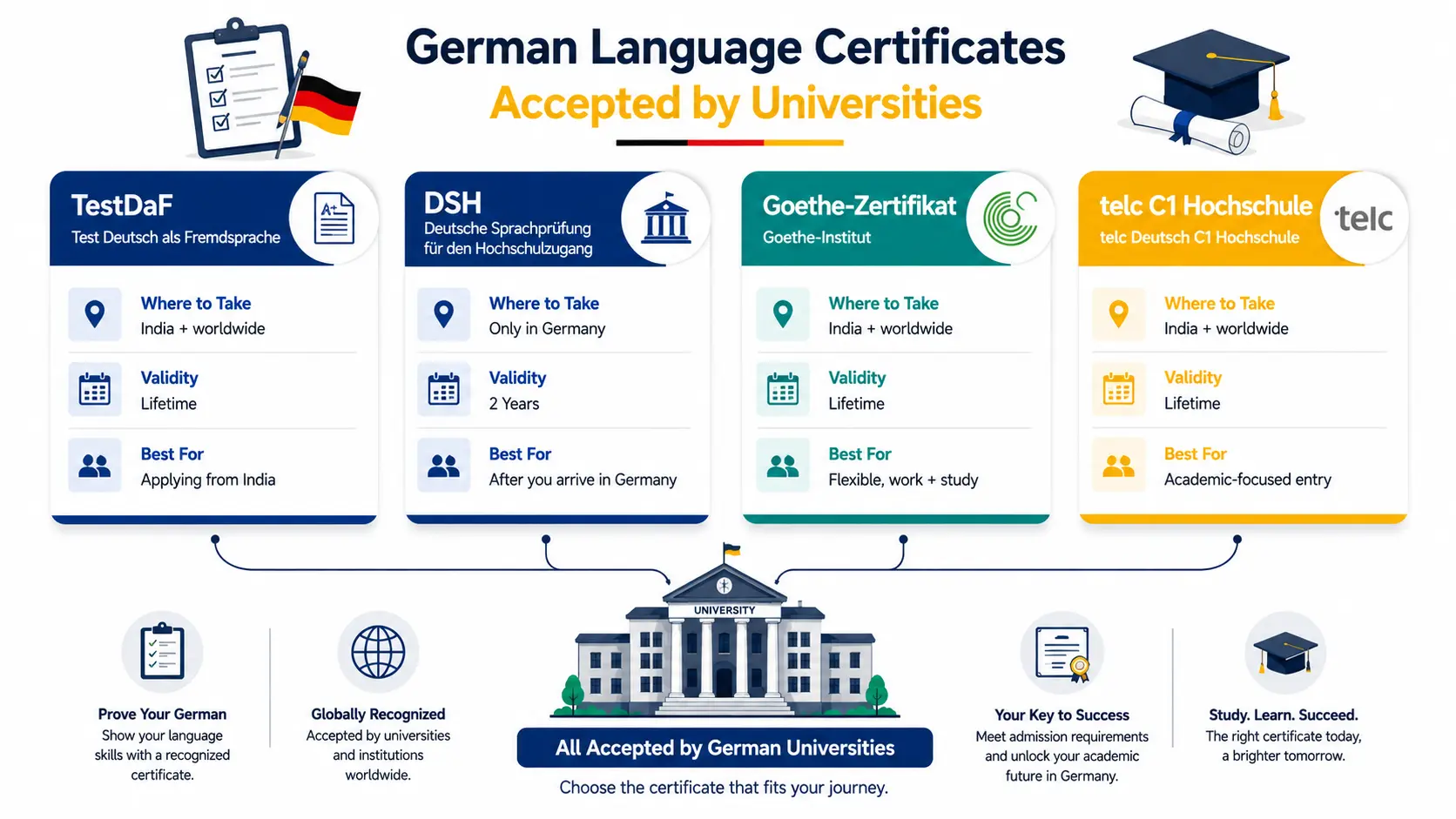
If your program is in German, you'll need to prove your level with a recognised certificate. The four that matter most:
TestDaF is the most practical choice for Indian students. It's accepted by every German university, can be taken at test centres right here in India, and has lifetime validity. Scores are reported as TDN 3, 4, or 5, mapping to the B2–C1 range, with TDN 4 across all sections being the common benchmark.
DSH is administered by individual German universities and can only be taken in Germany. DSH-2 corresponds to C1 and is the typical requirement. A strong option once you've arrived, but not something you can complete from India.
Goethe-Zertifikat is awarded by the Goethe-Institut (Max Mueller Bhavan in India) and is globally recognised. For university admission, you'll want C1 or C2.
telc Deutsch C1 Hochschule is purpose-built for university entry and focuses entirely on academic German.
Certificate | Where to Take | Validity | Best For |
TestDaF | India + worldwide | Lifetime | Applying from India |
DSH | Only in Germany | 2 years | After you arrive |
Goethe-Zertifikat C1/C2 | India + worldwide | Lifetime | Flexible, work + study |
telc C1 Hochschule | India + worldwide | Lifetime | Academic-focused entry |
For most students applying from India, TestDaF or Goethe-Zertifikat C1 offers the best mix of recognition and convenience.
Special Case: The Studienkolleg
If your Indian qualification doesn't directly meet German university entry requirements common for students with only 12 years of schooling you may need a one-year foundation course called a Studienkolleg.
Most Studienkollegs ask for B1 to apply, but realistically you'll need B2 to clear the entrance exam (the Aufnahmeprüfung) and follow the coursework, which is delivered in German. Think of the year as a bridge: you enter at B2 and graduate at C1, certified by the final Feststellungsprüfung which is also the level you'll need for direct university admission afterwards.
German Level for the Student Visa
A common point of confusion: the student visa itself has no fixed CEFR requirement. You submit whichever language certificate your admission demands. For a German-taught program, that means your B2/C1 proof; for an English-taught one, your IELTS or TOEFL scores.
So the language requirement comes from your university, not the visa office. That said, showing basic German strengthens your visa interview and signals that you're serious about integrating.
Learning German from Zero in India
In India, your main options are the Goethe-Institut / Max Mueller Bhavan centres (in metros like Bengaluru, Delhi, Mumbai, Chennai, and Kolkata), reputable private German-language institutes, and online platforms. Costs vary widely by intensity and provider, so budget per level rather than as a lump sum, and start early language preparation is usually the longest lead-time item in the whole application.
Match Your Level to Your Pathway
Rather than memorising a single answer, find your route:
- English-taught program? No German needed to apply. Aim for A2–B1 for daily life.
- German-taught program, direct entry? Target C1 (B2 may earn conditional admission).
- Need a foundation year? Enter your Studienkolleg at B2 and finish at C1.
Frequently Asked Questions
Is B2 enough to study in Germany?
B2 is often the minimum to apply, and some universities grant conditional admission at B2 if you reach C1 before the semester starts. However, C1 is the standard for most German-taught programs and the safer choice for handling lectures and exams comfortably.
Can I study in Germany without learning German?
Yes. Germany offers around 2,400 English-taught programs, mostly master's degrees, where you prove English ability through IELTS or TOEFL. You won't need German for admission, though A2–B1 helps with your visa, part-time work, and everyday life.
Which test should Indian students take TestDaF or DSH?
TestDaF is the practical choice: it can be taken in India, is accepted by all German universities, and has lifetime validity. DSH can only be taken in Germany, so it suits students who have already arrived.
What German level is needed for a student visa?
The visa has no fixed CEFR level you submit whatever your admission requires. German-taught programs need B2/C1 proof; English-taught applicants submit English scores. Basic German still strengthens your visa interview.