

Finishing Class 12 and dreaming of a degree overseas? You are far from alone. According to India's Bureau of Immigration data shared in Parliament, more than 7.5 lakh Indian students went abroad to study in 2024 and lakhs of them began that journey straight after school. Studying abroad after 12th is one of the biggest decisions you will make, and this guide walks you through every part of it: which countries make sense in 2026, what you can study, how much it costs, the exams you need, and the exact timeline to follow.
Should You Study Abroad After 12th?
The honest answer: it depends on your goals, your budget, and your appetite for change. An international degree can open doors that a domestic one may not global exposure, world-class faculty, research facilities, and the chance to settle into a country's job market early. Starting your undergraduate degree abroad also means you spend more years in that system, which often makes post-study work and immigration smoother later.
But it isn't the right path for everyone. Living independently at 17 or 18, far from family, is demanding. The costs are significant, and not every course or career genuinely requires a foreign degree. Before committing, ask yourself three questions: Can my family afford it (or can I fund it through loans and scholarships)? Is my chosen field genuinely better served abroad? Am I ready to handle life on my own in a new culture?
If the answers point toward “yes,” the next step is choosing where to go.
Best Countries to Study Abroad After 12th in 2026
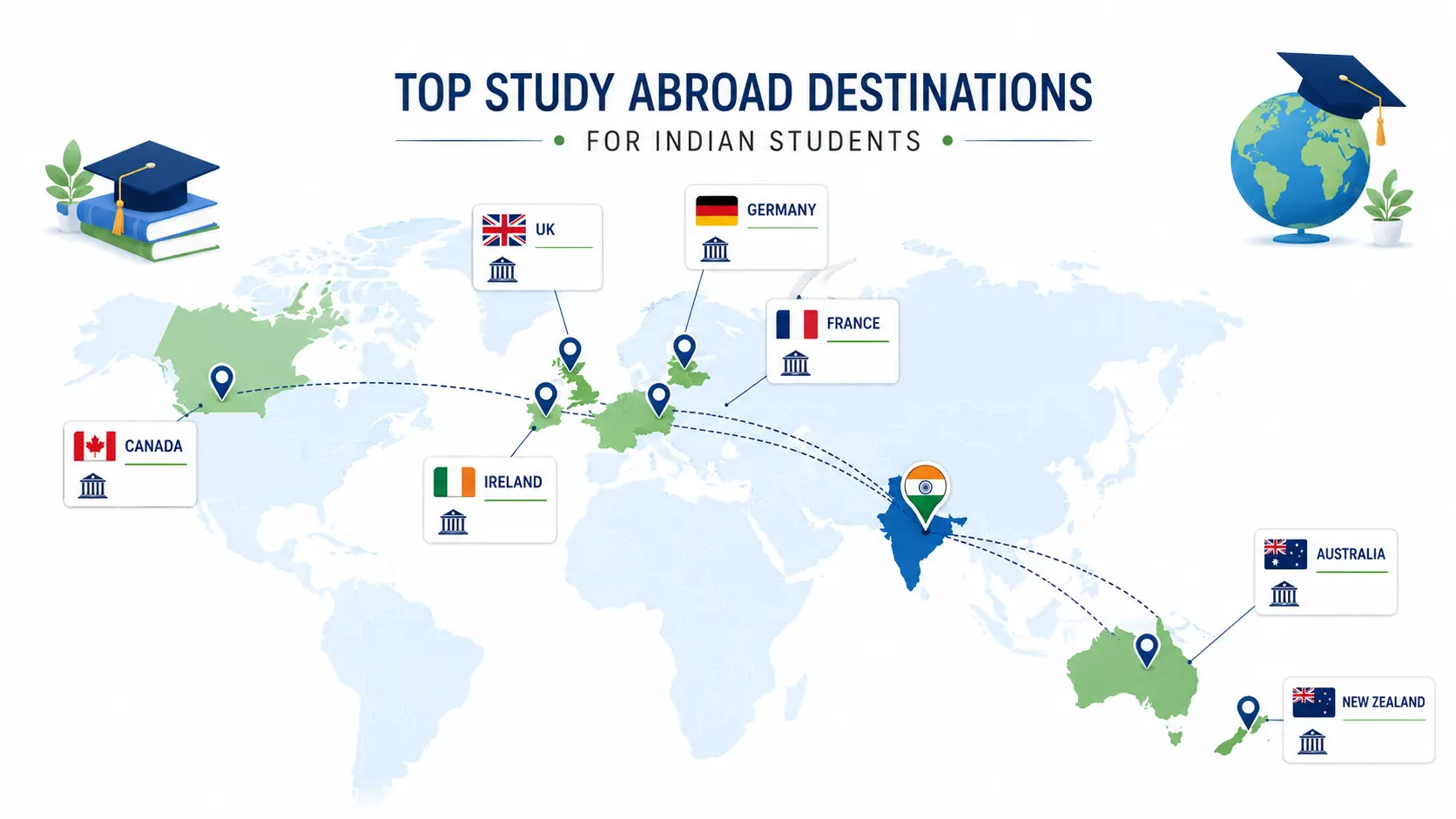
The map of where Indian students go has shifted noticeably in the last two years, and 2026 looks different from 2023. The number of Indian students heading abroad actually dipped by roughly 15% in 2024, driven largely by tighter visa rules in some traditional destinations. So choosing a country today means weighing not just rankings and cost, but also how realistic the student visa is.
Established English-speaking destinations:
- New Zealand — All eight universities are globally ranked, with strong research credentials, one of the most generous post-study work visas, and a safe, high-quality student lifestyle.
- United Kingdom — Shorter three-year undergraduate degrees save you a year of fees, and demand from Indian students remains strong with high visa approval rates at degree level.
- Canada — Once the default for affordability and immigration, Canada saw a sharp drop in Indian enrolments after it tightened study-permit rules. Still viable, but research current intake caps carefully.
- Australia — Strong universities and post-study work options, though it has increased scrutiny of applications.
Rising affordable destinations:
- Germany — Low or zero tuition at public universities, strong engineering and sciences. Indian student numbers here have climbed steadily.
- France — Increasingly recruiting Indian students, with a stated goal of welcoming 30,000 of them by 2030, plus a growing range of English-taught programs.
- Ireland — A friendly English-speaking option with a solid tech and pharma job market.
How do you choose? Match the country to your priority. If rankings and research strength matter most, lean toward the UK or New Zealand. If you want to control costs, look hard at Germany, France, and Ireland. If long-term settlement is the goal, study the country's current post-study work and visa policies before anything else.
Popular Courses to Study Abroad After 12th
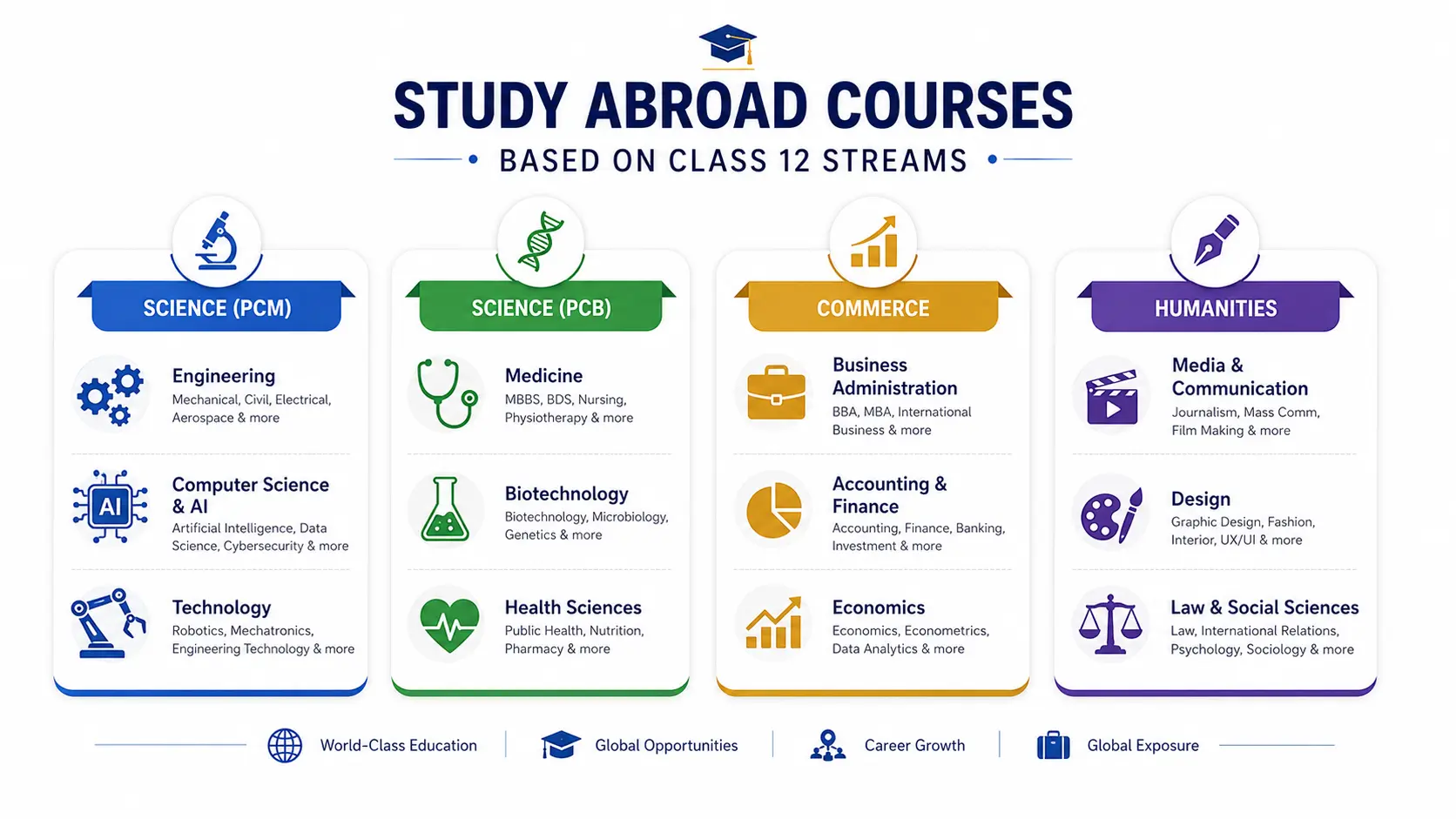
What you can study depends largely on your Class 12 stream.
- After Science (PCM): Engineering, computer science, data science, artificial intelligence, architecture, and pure sciences. STEM fields are heavily favoured abroad and often come with strong job prospects.
- After Science (PCB): Nursing, biotechnology, pharmacy, public health, psychology, and biomedical sciences. (Note: an MBBS abroad has its own separate eligibility and licensing path research it carefully.)
- After Commerce: Business administration, finance, accounting, economics, and management. Many universities offer well-regarded undergraduate business degrees.
- After Arts/Humanities: Liberal arts, media and communication, design, law, international relations, and hospitality.
If your 12th marks or subjects don't quite meet a university's direct-entry requirement, foundation and pathway programs are a common bridge. These one-year courses prepare you academically and language-wise before you join the main degree especially useful for destinations like Germany.
Eligibility & Entrance Exams
Academic eligibility: Most universities expect 60–70% in Class 12, though top institutions can ask for 80% or higher. Your subject combination must align with your intended course.
English proficiency tests: Since you'll study in English, you'll usually need to prove your command of it. The most accepted test is IELTS, but TOEFL, PTE, and the Duolingo English Test are widely recognised too. Required scores vary, but a band of 6.0–6.5 in IELTS is a common undergraduate benchmark.
Standardized tests: Most popular destinations for Indian students including New Zealand, the UK, Canada, and Australia admit undergraduates on Class 12 marks plus an English test, without a separate aptitude exam like the SAT.
Can you study abroad without IELTS? Yes, in many cases. Some universities waive the English test if your medium of instruction in school was English, or they offer their own internal assessment. That said, IELTS remains the safest, most universally accepted option, so prepare for it unless you're certain of a waiver.
Step-by-Step Application Process & Timeline
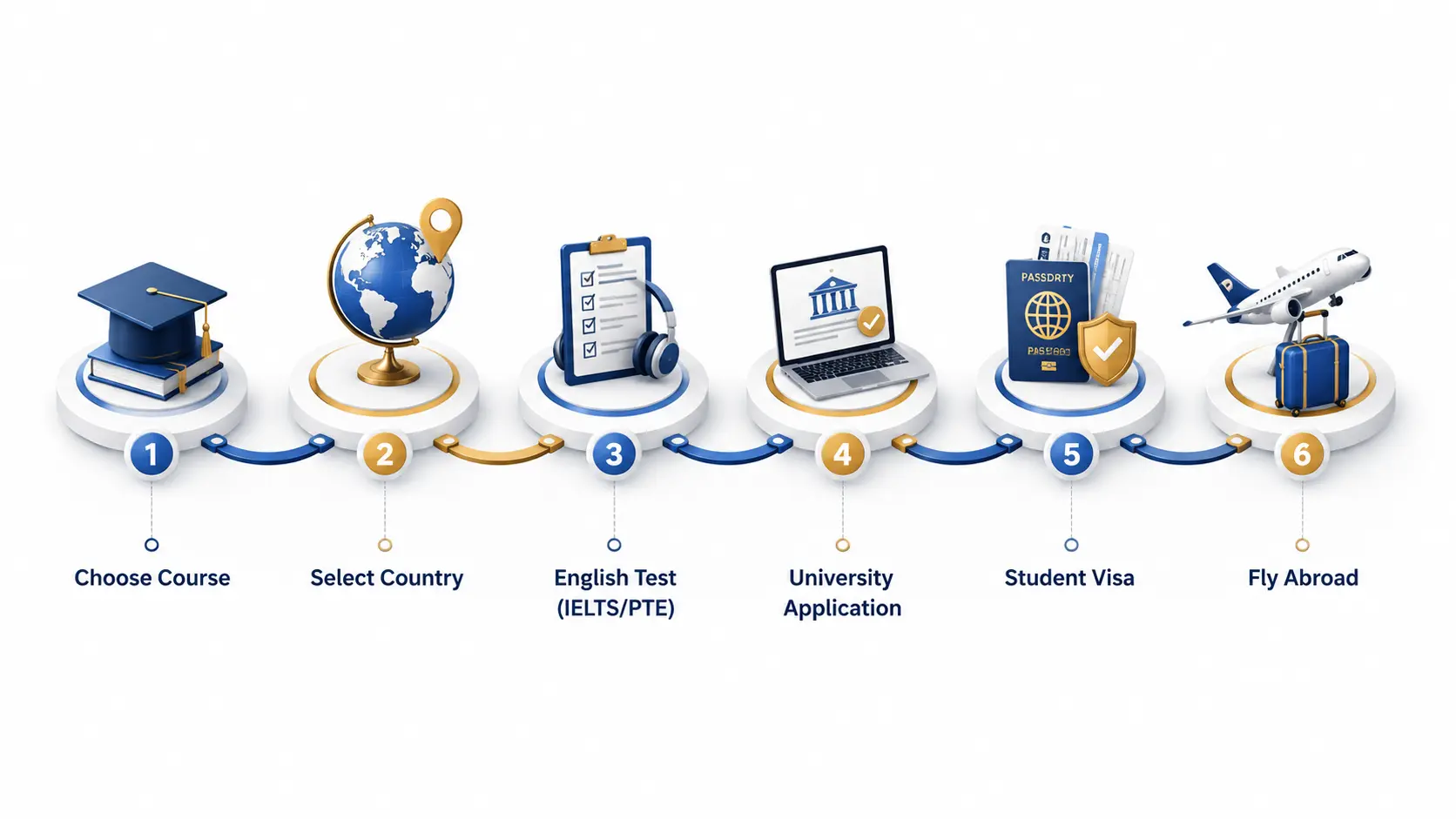
The biggest mistake beginners make is starting late. Ideally, begin 12 to 18 months before your intended start date.
- 12–18 months before: Research countries, universities, and courses. Shortlist 8–12 universities across “ambitious,” “realistic,” and “safe” categories. Note their deadlines and entry requirements.
- 9–12 months before: Register and prepare for required tests (IELTS, SAT if needed). Start drafting your Statement of Purpose (SOP) and arranging letters of recommendation.
- 6–9 months before: Submit applications. Track each university's deadline carefully, since intakes differ by country.
- 3–6 months before: Accept your offer, arrange finances and loans, then apply for your student visa and book accommodation.
Many families choose to work with a study abroad consultant during this period. Reputed study abroad consultants in Angamaly can help students shortlist universities, prepare applications, and avoid common mistakes throughout the admission process. A good consultant can save time and reduce errors but vet them carefully, and never rely on anyone who guarantees admission or visas, because no one legitimately can.
Cost of Studying Abroad After 12th
Cost is usually the deciding factor, so plan with realistic numbers. Total annual cost tuition plus living expenses varies widely:
- Affordable destinations (Germany, France): roughly ₹8–15 lakh per year, sometimes less where public tuition is minimal.
- Mid-range (Ireland, parts of Europe): roughly ₹15–25 lakh per year.
- Premium destinations (New Zealand, UK, Australia): roughly ₹25–45 lakh per year.
Don't forget the hidden costs: application fees, test fees, health insurance, flights, visa charges, and a security deposit for accommodation. Build these into your budget from the start so there are no surprises.
Scholarships & Education Loans
Studying abroad is expensive, but it's rarely a fully out-of-pocket exercise.
Scholarships: Universities offer merit-based scholarships, and there are government and private schemes for Indian students. Apply early many scholarships have deadlines well before the main application.
Education loans: Indian banks and NBFCs offer education loans covering tuition and living costs. Loans above a certain amount usually need collateral, while smaller amounts may be unsecured. Compare interest rates, moratorium periods, and processing time before committing.
Part-time work: Most study destinations allow international students to work a limited number of hours per week (commonly around 20 hours during term). This helps with living expenses but rarely covers tuition, so don't bank on it as your primary funding.
Student Visa Process
Once you have an offer and your finances in place, the student visa is the final major hurdle.
You'll generally need your offer letter, proof of funds, academic and test certificates, a valid passport, and often proof of accommodation. Each country has its own format and financial thresholds, so follow the official embassy checklist exactly.
Why visas get rejected and how to avoid it: The most common reasons are insufficient or unclear proof of funds, weak documentation, and inconsistencies between your application and interview answers. Avoid this by keeping your financial documents clean and well-organised, being honest, and ensuring every detail matches across your application.
Common Mistakes Indian Students Make
A few avoidable errors trip up beginners every year:
- Starting too late and missing application or scholarship deadlines.
- Choosing a country on reputation alone without checking current visa conditions a critical factor in 2026.
- Underestimating total costs by budgeting only for tuition.
- Copy-pasting SOPs instead of writing genuine, specific statements.
- Falling for “guaranteed admission” promises from unverified agents.
Awareness of these alone puts you ahead of most first-time applicants.
Frequently Asked Questions
Which is the best country to study abroad after 12th for Indian students?
There's no single best country it depends on your budget, course, and career goals. The UK and New Zealand lead for rankings and research, Canada and Australia for work options, and Germany and France for low or no tuition. Match the destination to your priorities.
How much does it cost to study abroad after 12th from India?
Costs typically range from ₹8–15 lakh per year in affordable destinations like Germany or France to ₹25–45 lakh per year in New Zealand, the UK, or Australia, including tuition and living. Scholarships and education loans can significantly reduce this burden.
What percentage is required to study abroad after 12th?
Most universities expect 60–70% in Class 12, though top institutions may ask for 80% or higher. Requirements vary by country and course. Strong English test scores, a good statement of purpose, and extracurriculars can often offset slightly lower marks.
Is IELTS mandatory to study abroad after 12th?
Not always. Many universities accept TOEFL, PTE, or Duolingo instead, and some waive English tests entirely if you studied in an English-medium school or take their internal test. However, IELTS remains the most widely accepted, so it's the safest option.
Final Thoughts
Studying abroad after 12th is a big, exciting step and entirely achievable with the right planning. Start early, choose a country that fits your goals and budget rather than just its reputation, prepare for your exams, and budget honestly. The students who succeed aren't always the ones with the highest marks they're the ones who plan ahead and stay organised.