

For over a decade, Canada was the default choice for Indian students chasing a foreign degree and a clear path to permanent residency. In 2026, that path is still open but it looks very different. The Student Direct Stream is gone, the money you must show has more than doubled, work-permit rules have tightened, and approval is no longer close to guaranteed. If you are planning a January, May, or September 2026 intake, here is exactly what changed and how to build an application that gets approved.
What changed for Indian applicants in 2026: the short version
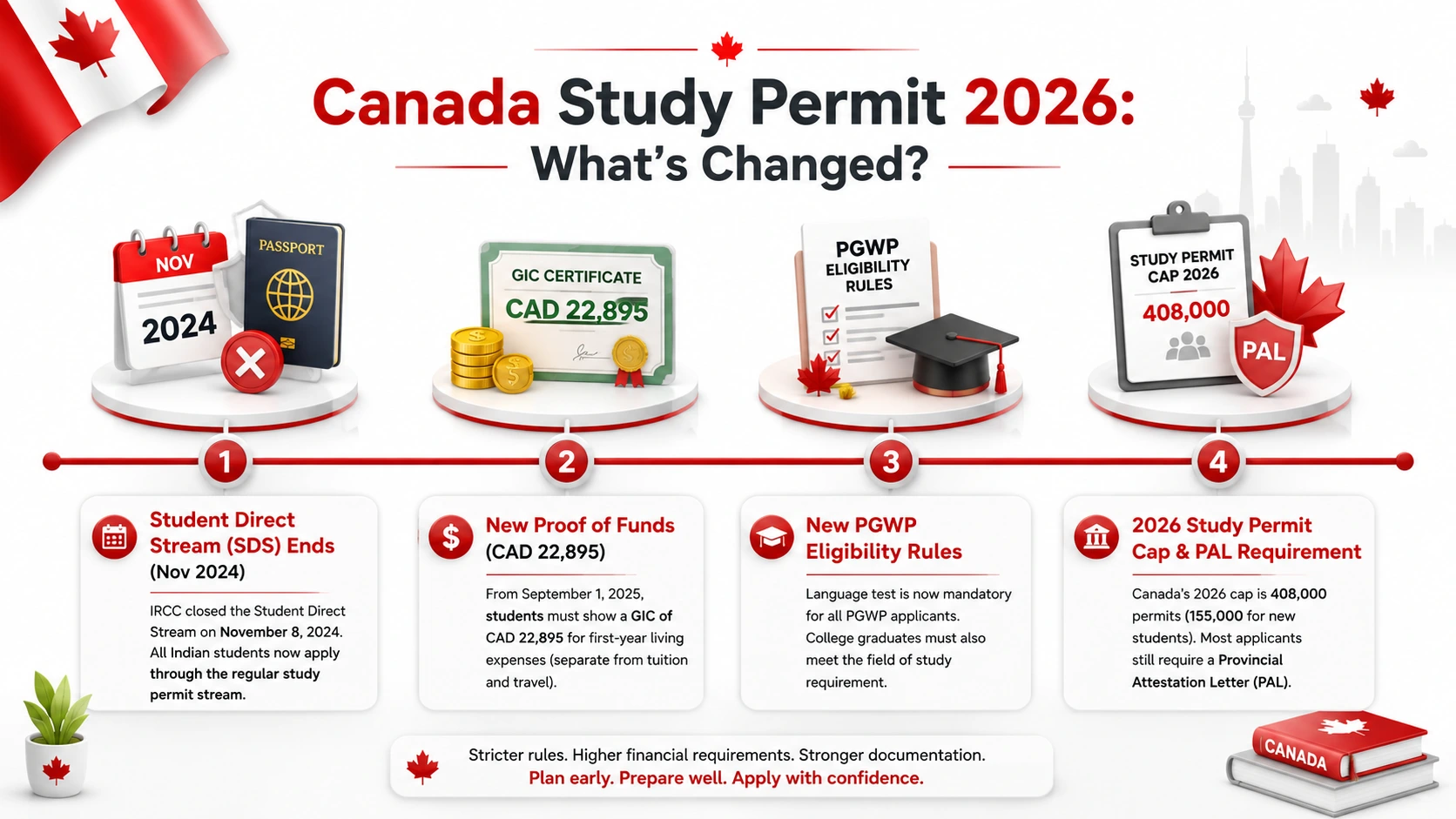
- The Student Direct Stream (SDS) is closed. Everyone now applies through the single regular study permit stream.
- Proof of funds jumped to a GIC of CAD 22,895 (roughly ₹14–15.5 lakhs), separate from tuition and travel.
- PGWP rules are stricter a mandatory language test and, for college graduates, a field-of-study requirement.
- A Provincial Attestation Letter (PAL) is still required for most applicants.
- Refusal rates for Indian students rose sharply, so documentation quality now decides outcomes.
SDS has ended: what it means for Indian students
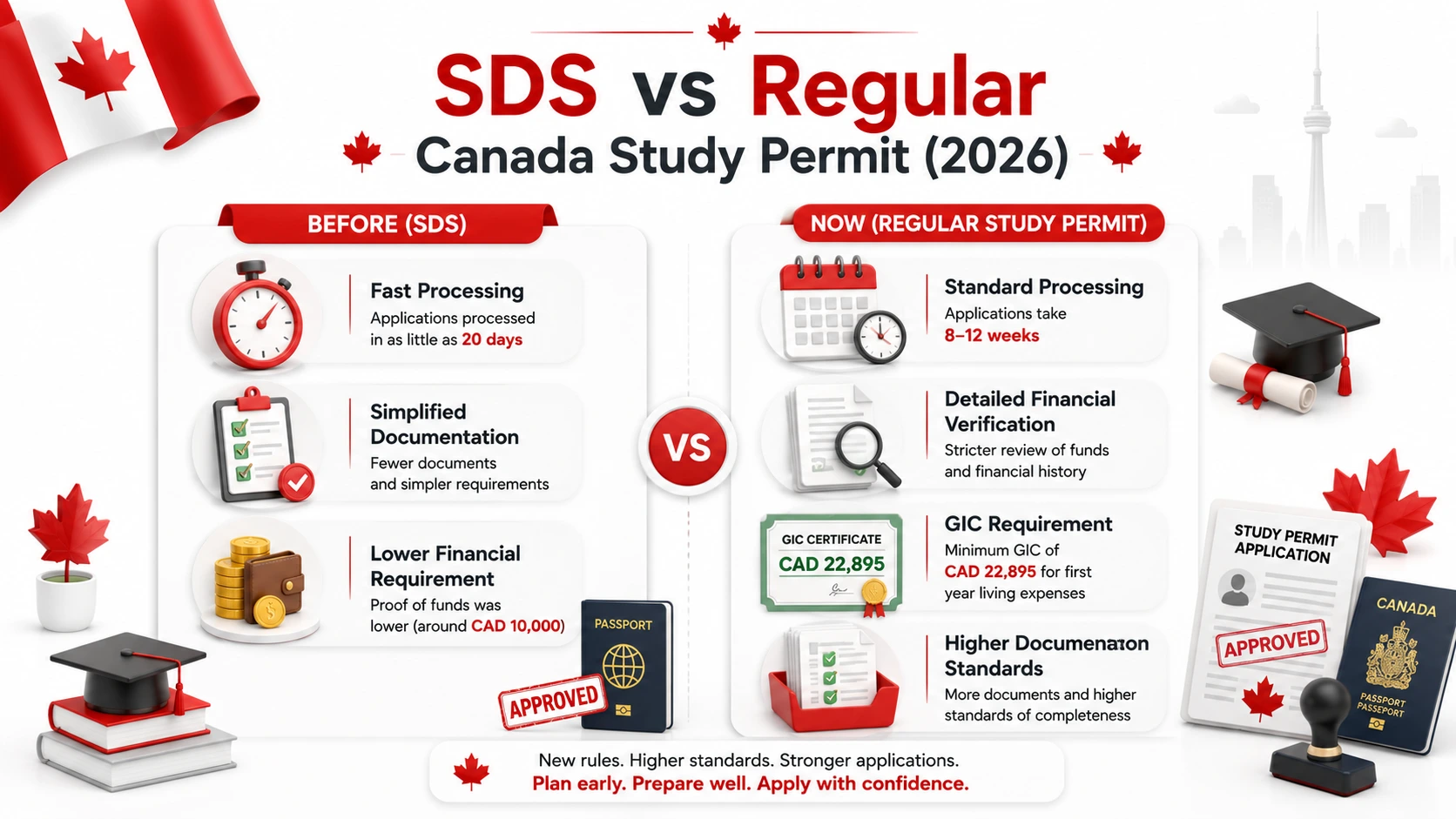
On November 8, 2024, Immigration, Refugees and Citizenship Canada (IRCC) closed the Student Direct Stream, the fast-track route that once processed eligible applications in as little as 20 days. India was one of the 14 countries the SDS served, so the change hit Indian applicants directly.
Every study permit application now goes through the same regular stream, regardless of nationality. In practice that means longer processing typically 8 to 12 weeks and heavier scrutiny of your finances and genuine intent to study. There is no priority lane to buy into anymore a strong file is the only advantage available.
The numbers show how consequential this has been. Study permits issued to Indian students fell from roughly 278,000 in 2023 to about 188,000 in 2024, with 2025 projected near 90,000 a drop of more than half in a single year. Applications themselves collapsed, and by August 2025 the refusal rate for Indian applicants had climbed to around 74%, compared with roughly 32% two years earlier. India now records the highest refusal rate among Canada's major source countries.
The takeaway is not “don't apply.” Indian students still make up close to a third of everyone studying in Canada. The takeaway is that in 2026, a careless or poorly documented application is very likely to be refused, while a clean, well-evidenced one still gets approved.
If you're planning your Canada education journey, consulting an experienced study abroad consultant in Angamaly can help you prepare accurate financial documents, choose the right institution, and submit a stronger study permit application that aligns with the latest IRCC requirements.
New proof-of-funds and GIC rules for 2026
The single biggest change for Indian families is money. For applications filed on or after September 1, 2025, a single student outside Quebec must show at least CAD 22,895 in living expenses for the first year separate from tuition and travel. In Quebec the figure is higher still. For most Indian students, this amount is arranged through a Guaranteed Investment Certificate (GIC): money transferred to a Canadian bank before you apply, then returned to you in monthly instalments after you arrive.
That CAD 22,895 works out to roughly ₹14–15.5 lakhs depending on the exchange rate, and it is more than double the amount required before 2024, when the threshold had been frozen at CAD 10,000 for nearly two decades. It is not a fee it is your own money, held in trust to prove you can support yourself.
Most families fund Canada through a mix of savings and an education loan. Indian banks and NBFCs lend anywhere from about ₹7.5 lakh to ₹1.5 crore for Canadian study, with public banks such as SBI and Bank of Baroda offering the lowest interest rates and private lenders like HDFC Credila and Avanse offering faster, sometimes collateral-free options. Loans above ₹7.5 lakh usually require collateral, a parent co-borrower is standard, and interest paid is eligible for a tax deduction under Section 80E.
Two timing points trip up otherwise well-funded applicants:
- The GIC must be in place before you submit your study permit application. Since the permit now takes 8–12 weeks to process and loan sanction takes days to a few weeks, start your loan process four to five months before your intake.
- Your paperwork must be consistent. The most common reason funded students get refused is not a lack of money it is unexplained large deposits, or bank statements, loan letters, and GIC certificates that don't line up. Document the source of every major deposit.
First-year cost snapshot for Indian students (2026)
|
Cost item |
Approximate amount |
|
GIC / living expenses (mandatory) |
CAD 22,895 (₹14–15.5 lakhs) |
|
First-year tuition (varies by program) |
CAD 20,000–45,000 |
|
Travel & incidentals |
CAD 3,000 |
|
Education loan range (Indian lenders) |
₹7.5 lakh – ₹1.5 crore |
|
Typical first-year total |
₹23–41 lakhs |
New PGWP rules for 2026
The Post-Graduation Work Permit (PGWP) the up-to-three-year work permit that makes Canada a PR pathway rather than just a degree has its own new rules, effective for applications on or after November 1, 2024.
Language: Every PGWP applicant must now pass an approved English or French test. Graduates of bachelor's, master's, or doctoral programs need Canadian Language Benchmark (CLB) 7 roughly IELTS 6.0 in each band. College and other non-degree graduates need CLB 5, around IELTS 5.0–5.5 per band. Plan your test scores well before you graduate.
Field of study: College and non-degree graduates must also have studied in an eligible field, tracked by CIP code and aligned to Canada's long-term labour shortages. Degree graduates (bachelor's and above) are exempt from this requirement.
Grandfathering: If you applied for your study permit before November 1, 2024, you are exempt from the new field-of-study rule. This is the single most misunderstood point among current students your eligibility is generally locked to the rules that applied when you first committed to study.
One caution: IRCC reinstated 178 previously removed fields in July 2025, but that list was under review in early 2026 and could change again. If your plan depends on PGWP eligibility, confirm your specific program's status on canada.ca before you enrol.
The study permit cap and the PAL
Canada caps how many study permit applications it will process each year. For 2026 the target is 408,000 permits in total, including just 155,000 for newly arriving students a roughly 50% cut from 2024 levels. That competition is one reason approval has become harder.
Most applicants must include a Provincial Attestation Letter (PAL), which confirms your application counts within your province's share of the cap. From January 1, 2026, one welcome exception applies: master's and doctoral students at public designated learning institutions no longer need a PAL. Because provincial allocations can fill up during busy intakes, apply as early as your documents allow.
What smart Indian applicants are doing in 2026
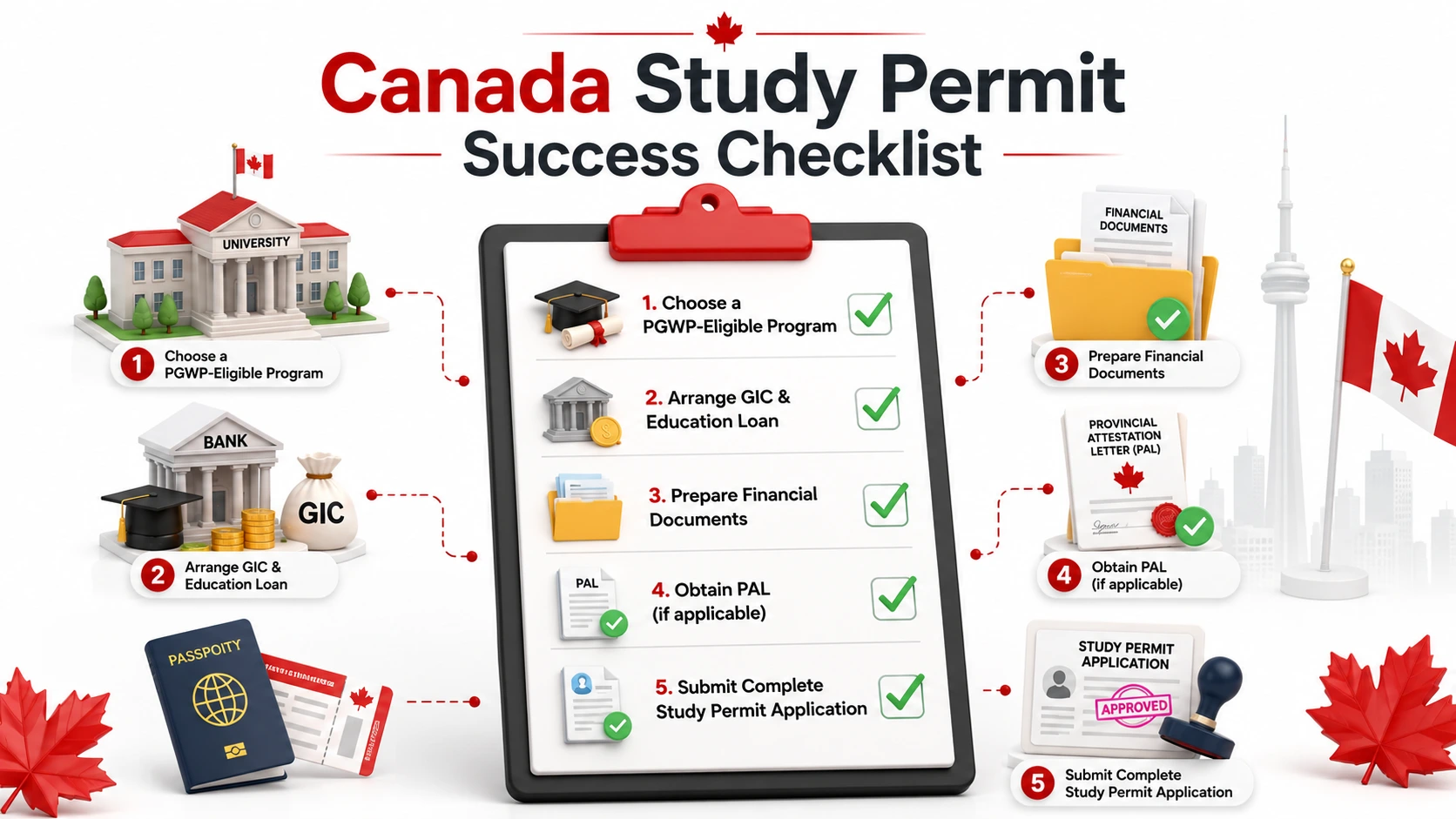
The students getting approved this year treat the new rules as a strategy, not just a hurdle:
- Choosing PGWP-safe programs. They pick degree programs, or confirm their college program's field is eligible before enrolling because a program that doesn't lead to a work permit rarely justifies the loan.
- Targeting lower-cost provinces. Living costs in Atlantic Canada run far below Toronto or Vancouver, easing both the budget and the proof-of-funds burden.
- Using the graduate route. A master's at a public university now skips the PAL and builds a stronger PR profile increasingly attractive for students who can fund it.
- Documenting funds obsessively. They show a clean money trail, explain every deposit, and keep loan, bank, and GIC papers perfectly aligned.
Frequently asked questions
Is SDS still available for Indian students in 2026?
No. IRCC closed the Student Direct Stream on November 8, 2024, and India was one of the 14 eligible countries. All Indian applicants now use the single regular study permit stream, with no fast-track option, so complete and well-documented financial proof matters more than ever.
What is the GIC amount for Canada in 2026?
Indian students must show a GIC of CAD 22,895 (roughly ₹14–15.5 lakhs) for first-year living costs, separate from tuition and travel. This is more than double the pre-2024 figure. The money is your own and is returned to you in monthly instalments after you arrive in Canada.
Can I use an education loan as proof of funds?
Yes. Approved education loan sanction letters from Indian banks are accepted, and most families finance Canada this way. The GIC portion, however, must be transferred and held in a Canadian bank account before you apply, so plan your loan disbursement around that deadline.
What is the refusal rate for Indian students now?
Refusal rates rose sharply reported around 74% in August 2025, versus roughly 32% two years earlier. Weak or inconsistent financial proof is a leading cause. A clean funding file and a genuine study plan are now decisive for approval.
What IELTS score meets the new PGWP language rule?
Degree graduates need CLB 7, roughly IELTS 6.0 in each band. College and non-degree graduates need CLB 5, about IELTS 5.0–5.5 per band. These apply to applications submitted on or after November 1, 2024, so plan your scores before graduation.
Do Indian students need a PAL?
Most do. From January 1, 2026, master's and doctoral students at public designated learning institutions are exempt. Provincial slots can fill during peak intakes, so apply early.
Key takeaways
Canada in 2026 is more expensive, more competitive, and more demanding than it was two years ago but it is not closed. The students who succeed arrange their GIC and loan early, document every rupee cleanly, choose programs that lead to a PGWP, and apply the moment their file is ready. Get those four things right and you put yourself firmly in the minority that still gets approved.