
?unique=ac3fe2e)
If you’re planning a master’s in Germany and just heard about a new exam called the dMAT, take a breath. The most important thing to know upfront is this the dMAT is not mandatory for everyone. Whether you actually need it comes down to just three factors your target intake, your degree field, and when you started your APS process.
This guide gives you a clear, self-diagnosis checklist so you can decide in a couple of minutes whether the dMAT applies to you, who’s exempt, and what the 2026 deadlines mean for your plans.
What Is the dMAT and Why It Now Matters for APS
The dMAT (digital Master Test) is a standardised academic aptitude test run by g.a.s.t., the same body behind TestAS. From the Summer Semester 2027 intake onward, it becomes a new required document within the APS process for certain Indian master’s applicants.
Here’s the key distinction the dMAT does not replace your APS certificate, and it doesn’t replace document verification. APS India continues to check the authenticity of your academic records exactly as before. The dMAT simply becomes one additional certificate that sits inside your APS file issued separately by g.a.s.t. and referenced on your final APS certificate.
It’s also worth knowing what the dMAT isn’t. It’s not a university entrance exam, it’s not a language test, and for now it applies only to Indian applicants. As of 2026, it has not been introduced for students from other countries such as China or Vietnam.
dMAT Eligibility Criteria for APS (2026): The 3-Factor Check
You only need the dMAT if all three of the following are true. If even one doesn’t apply to you, you’re exempt.
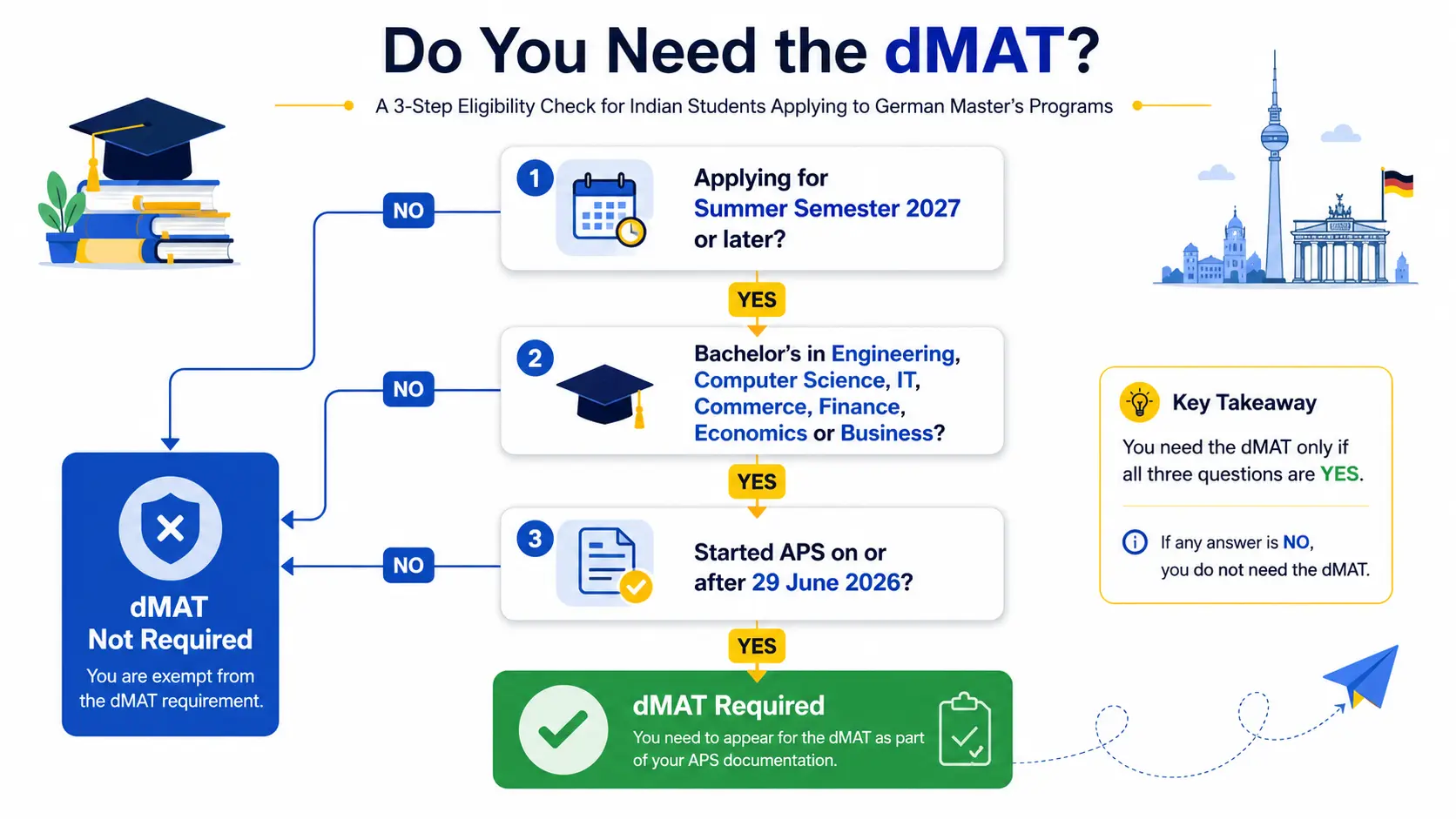
Factor 1 — Is your target intake Summer 2027 or later?
The requirement begins with the Summer Semester 2027 intake. If you’re applying for Winter Semester 2026/27, you are not affected at all and can proceed under the existing APS process.
Factor 2 — Is your degree in an affected field?
In its first phase, the dMAT applies only if your bachelor’s degree is in one of these areas:
- Engineering (including computer science and IT)
- Commerce and accounting
- Finance and economics
- Business and management
If your degree sits outside these fields arts, humanities, pure sciences, medicine you don’t need the dMAT under current rules. If your programme is interdisciplinary (say, Business Analytics or Industrial Engineering), check your classification against the official APS list of affected fields before assuming either way.
Factor 3 — When did you start your APS process?
This is the factor most students misread. The cut-off date is 29 June 2026. If you started your APS process on or after that date, the requirement can apply to you. If you started earlier, you’re protected more on that below.
Who Is Exempt from the dMAT for APS?
Transitional Exemption (29 June 2026 Cut-Off)
You are exempt if, before that date, you had already completed your APS online registration, shipped your complete APS documents, or received your APS certificate.
Key nuance: The cut-off is based on your submission date, not your certificate issue date. Documents submitted on 27 June with a certificate that arrives in July still qualify for exemption.
Exempt Degree Levels and Academic Fields
The dMAT is strictly for master’s applicants in the listed fields. Bachelor’s and PhD applicants don’t take it, and neither do master’s applicants whose degrees fall outside the affected areas.
Exchange, Double-Degree & Partnership Programme Exemptions
If you’re applying through an officially confirmed exchange, double-degree, or university-partnership programme, you’re exempt. You’ll submit a confirmation from your home institution, the German partner, or the programme coordinator along with your group number with your APS documents.
dMAT 2026 Registration Dates, Exam Schedule & Result Timeline
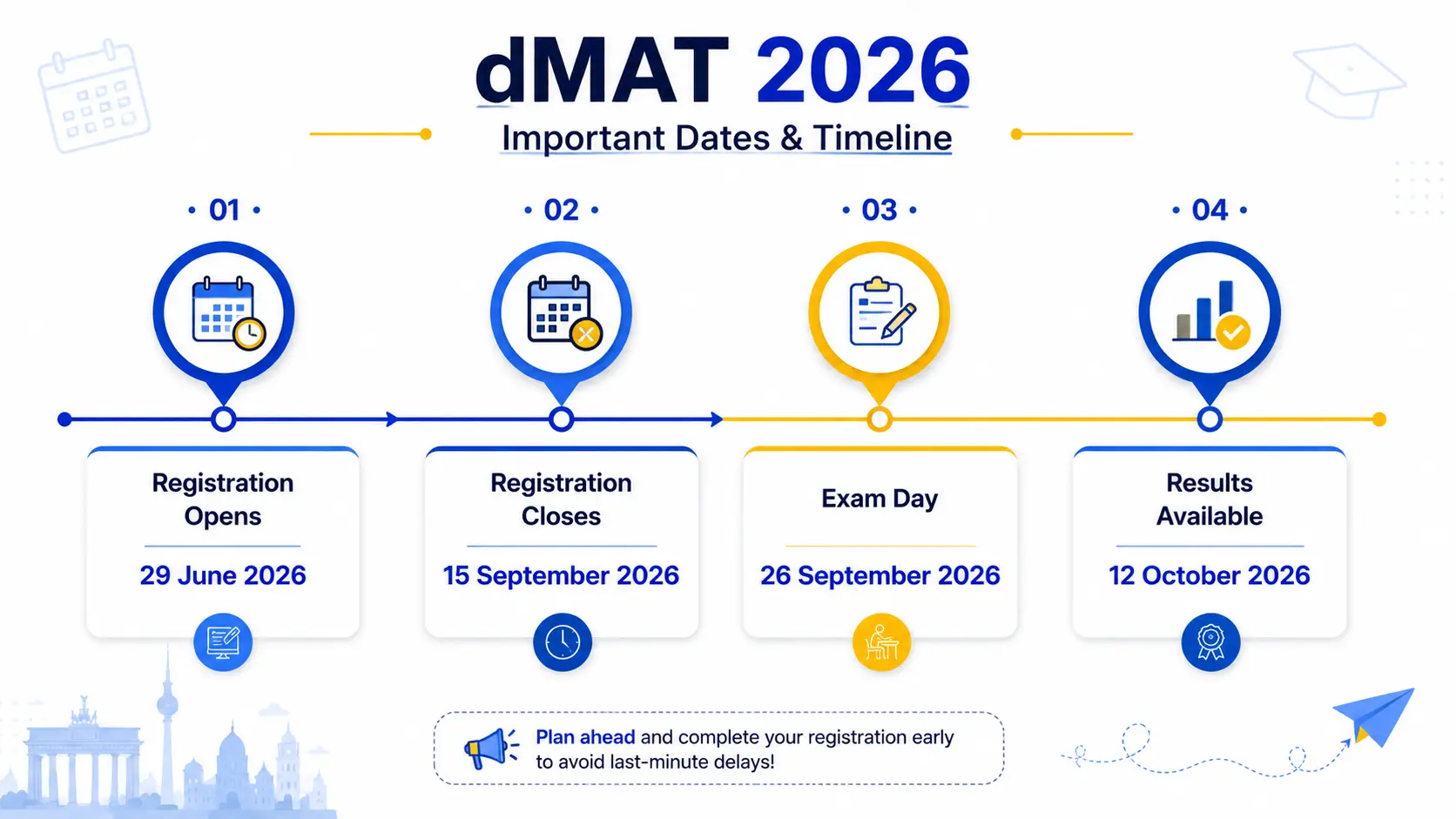
If the dMAT does apply to you, the calendar is tight and worth acting on now:
- Registration opened: 29 June 2026
- Registration closes: 15 September 2026
- First exam date: 26 September 2026
- Certificates available: from 12 October 2026
The exam is offered only on specific national testing dates not on demand so if you miss the September window, you wait for the next scheduled sitting. That waiting period can quietly push your entire application timeline back a full intake, which is why registering early matters more than the score itself.
dMAT Exam Fee, Test Format & Scoring Explained
dMAT Exam Fee
The dMAT fee is €150, roughly ₹16,300 at mid-2026 exchange rates (the euro–rupee rate moves daily, so confirm it on your payment day). You pay the full fee again for each retake.
dMAT Test Format
The test runs three and a half hours with a break, is taken in English, and uses single-choice questions across two parts: a Core Module measuring general cognitive and analytical skills, and a Subject Module (the General Academic Module) testing applied understanding in your field. Your results are reported as a dMAT score on a 0–200 scale (with an average of 100) plus a percentile rank showing how you performed relative to other test-takers.
Reassurance: There is no official pass mark, and a low score does not automatically fail your APS. Each German university decides independently how much weight to give your result.
Common Confusions, Cleared Up
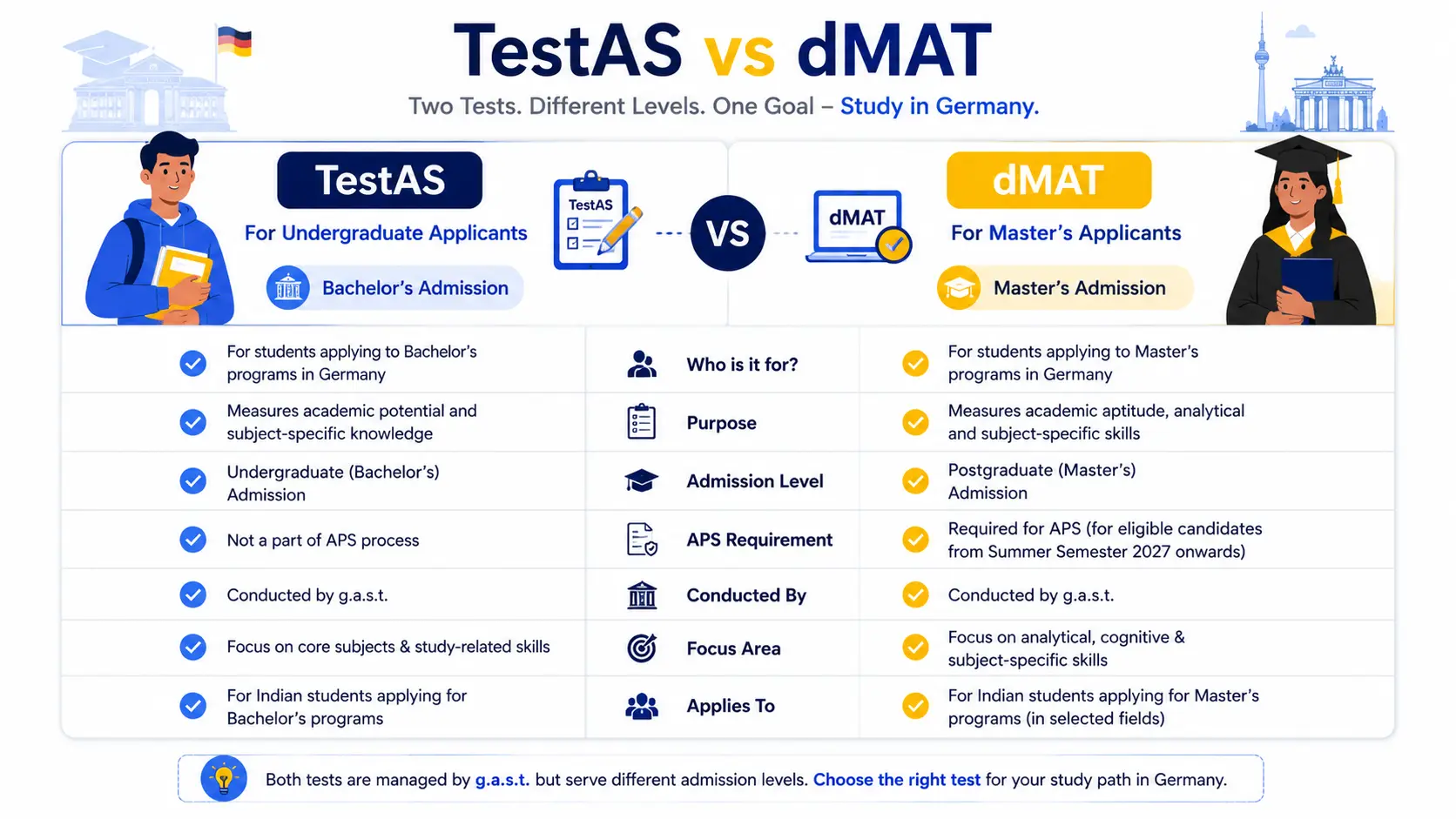
dMAT vs TestAS: These are different tests for different applicants. TestAS is for undergraduate (bachelor’s) applicants; the dMAT is specifically for selected master’s applicants.
Does the dMAT decide admission? No. Admission decisions belong to the universities. A strong dMAT score can strengthen your application at institutions that consider it Göttingen and RWTH Aachen already do for certain programmes but a good score doesn’t guarantee admission, and a weak one doesn’t automatically cause rejection.
Should You Rush Your APS Before the Cut-Off?
This is the strategic question the explainer articles avoid. If your APS process is already in motion, don’t scramble you’re likely exempt, and rushing an incomplete submission can create bigger problems than the dMAT itself. If you’re starting fresh and your field and intake fall under the requirement, don’t wait for the dMAT certificate before beginning APS. You can often submit your APS documents and add the dMAT certificate afterward, once results are published. Delaying your whole application because you think the certificate must come first is a common and costly mistake.
The bigger picture explains why Germany added this filter at all: India is now Germany’s largest source of international students, with around 60,000 enrolled, part of the more than 400,000 international students the country hosts overall. The dMAT is a quality-and-transparency measure layered onto an already competitive pipeline which is exactly why getting your eligibility and timing right is worth the effort.
What To Do Next
Run yourself through the three factors: intake, field, and APS start date. If any one clears you, you’re exempt proceed with your standard APS documents. If all three apply, register for the 26 September 2026 exam before the 15 September deadline, and keep your grades, language test, and other documents moving in parallel so nothing waits on a single piece.
If you’re unsure where your degree classification falls or whether your APS timing protects you, a quick profile review with an experienced study abroad consultant in Angamaly can help you understand your eligibility, avoid unnecessary delays, and confidently plan your APS and Germany admission process before booking your dMAT exam.
Frequently Asked Questions
Is the dMAT mandatory for every Indian master’s applicant?
No. The dMAT is required only if you meet all three conditions: you’re applying for the Summer Semester 2027 intake or later, your bachelor’s is in an affected field like engineering or business, and you started your APS process on or after 29 June 2026. Otherwise, you’re exempt.
Which degree fields require the dMAT?
In its first phase, the dMAT applies to bachelor’s degrees in engineering (including computer science and IT), commerce, accounting, finance, economics, business, and management. If your degree sits outside these fields such as arts, humanities, pure sciences, or medicine you don’t need it under current rules.
Am I exempt if I already began my APS application?
Yes. If you completed your APS online registration or shipped your complete APS documents before 29 June 2026, or already hold an APS certificate, you’re exempt under transitional rules. The cut-off is based on your submission date, not your certificate issue date.
Does the dMAT apply to the Winter 2026/27 intake?
No. Students applying for Winter Semester 2026/27 are not affected. The rule begins with the Summer Semester 2027 intake and any intake after that, so winter 2026/27 applicants can proceed under the existing APS process.
Will a low dMAT score fail my APS certificate?
No. A low score does not automatically cause APS India to refuse your certificate. The dMAT measures aptitude and is one document within your APS file. There’s no official pass mark each German university independently decides how much weight to give your score.
How much does the dMAT cost?
The dMAT fee is €150, roughly ₹16,300 at mid-2026 exchange rates (the rate moves daily, so confirm on your payment day). You pay the full fee again for each retake, and the test is only offered on specific national testing dates rather than on demand.